Bio Bay Kayak Tours in Puerto Rico: What to Expect, What to Wear, and Is It Worth It?
Bio bay kayak tours in Puerto Rico compared: Fajardo, Vieques and La Parguera prices, difficulty, what to wear, safety, photos, and an honest verdict.
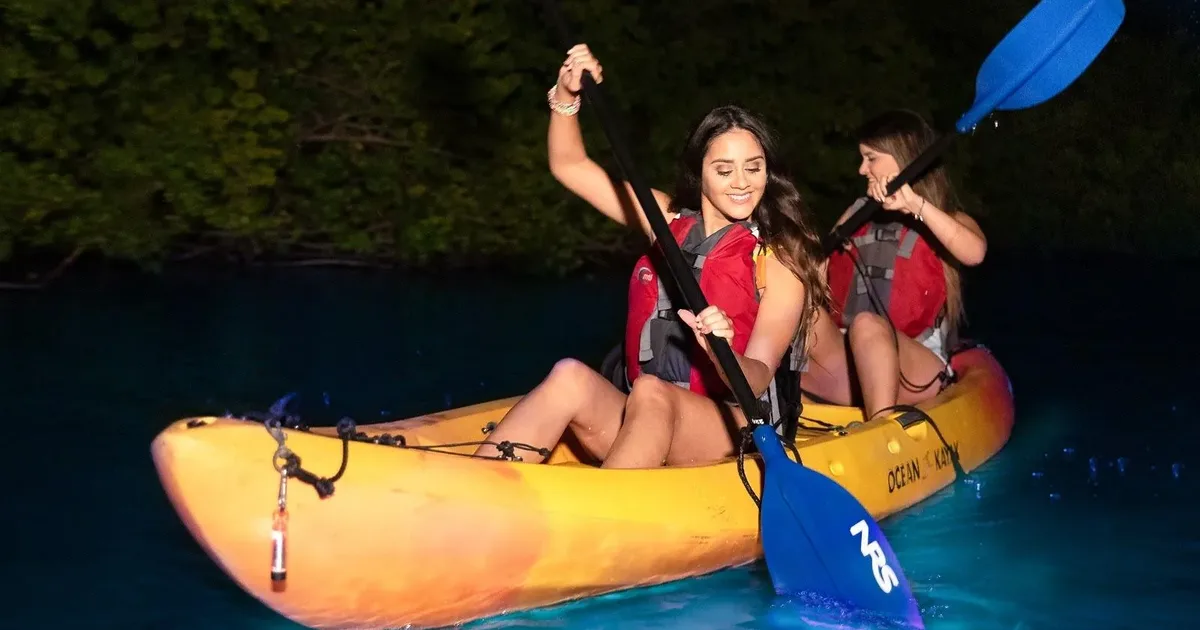
The first time you dip a paddle into a Puerto Rico bio bay on a dark night, the water answers back: a swirl of blue-green sparks that trails off your blade and drips from your fingertips. It’s one of the few travel experiences that lives up to the hype, if you pick the right bay, the right night and the right operator. This guide covers what happens on a bioluminescent bay kayak tour at Laguna Grande (Fajardo), Mosquito Bay (Vieques) and La Parguera (Lajas), how hard the paddling is, what to wear, what it costs in 2026, and our honest verdict on whether it’s worth your evening.
Prices and policies were checked on operator and booking pages in September and October 2026. They change often, so confirm before you book.
The short answer
- What it is: a guided night paddle of roughly 1.5 to 2.5 hours, usually in a two-person kayak, into a bay where microscopic dinoflagellates (Pyrodinium bahamense) flash blue-green every time the water moves.
- Which bay for kayaking: Mosquito Bay (Vieques) for the brightest glow and the shortest, easiest paddle; Laguna Grande (Fajardo) for the most adventurous paddle and the easiest logistics from San Juan; La Parguera if you’d prefer to go out by boat and swim.
- Price (2026): about $55–$90 per person for a standard kayak tour at the bay, $100–$125 or more with transport from San Juan. Vieques tours run about $57–$75, but you also need a ferry or flight and usually a night on the island.
- Is it worth it? Yes, for most able-bodied travelers it’s one of the best nights you’ll have in Puerto Rico, provided you go near the new moon, expect a sparkle instead of neon in your photos, and (in Fajardo) are ready for about an hour of real paddling.
If you’re still deciding whether to visit a bio bay at all, start with our guide to Puerto Rico’s three bioluminescent bays.
Check Availability
What is a bio bay kayak tour?
A bio bay kayak tour is a guided night paddle into a bioluminescent bay, where your paddle strokes, your hands and passing fish set off flashes of light from dinoflagellates. You can’t legally paddle Mosquito Bay or Laguna Grande on your own; licensed operators supply the kayak, life jacket, lights and a guide who explains the ecosystem as you go.
Puerto Rico has three bio bays: Mosquito Bay on Vieques, Laguna Grande in Fajardo and La Parguera in Lajas, according to Discover Puerto Rico, the official tourism site (last updated August 25, 2026). Each is a very different kayaking experience, which is why choosing the bay matters more than choosing the company.
Why does the glow only last a split second?
The glow is a defensive chemical reaction: luciferin is oxidized by the enzyme luciferase inside each cell when moving water deforms it. It’s fleeting. In a 2008 microfluidic study in the Journal of Experimental Biology (Latz and colleagues), Pyrodinium bahamense started glowing about 15–22 milliseconds after stimulation, and individual flashes averaged around 44 milliseconds in that setup. A 2024 PeerJ study measured first-flash durations for the same species of roughly 148–172 milliseconds. Either way, a single flash is over faster than a blink, so you see light only where the water is being disturbed, and the brightest trails follow your paddle. For the swimming rules bay by bay, see our guide to swimming in the bio bays.
Which bay is best for kayaking?
Mosquito Bay is the best bioluminescent kayaking in Puerto Rico for glow and ease; Laguna Grande is best for the paddle itself and for travelers based in San Juan. La Parguera is the best pick for swimmers and non-paddlers, because most “kayak” tours there take you out by boat first.
Kayak tours at Puerto Rico’s three bio bays compared (2026)
| Laguna Grande (Fajardo) | Mosquito Bay (Vieques) | La Parguera (Lajas) | |
|---|---|---|---|
| Typical tour length | About 2 hrs (15-minute lesson plus about 1.5 hrs paddling at Pure Adventure) | 1–2.5 hrs in total, often about 1 hr on the water (Black Beard Sports: about 2.5 hrs in total, about 1 hr kayaking) | About 2 hrs boat-assisted (Parguera Water Sports); 2.5–3 hrs paddle-only |
| Paddling distance and difficulty | About a 1-mile mangrove channel each way; about 2 miles round trip per Eco Adventures; moderate, and the return is often against the current | Short; Abe’s Snorkeling says you “do not have to paddle far” to reach the bioluminescence; easy | Boat-assisted: minimal paddling. Paddle-all-the-way tours about 3–3.5 miles, intermediate |
| Price per person (2026) | $55–$70 direct (Las Tortugas $55; Pure Adventure $59 plus a $3 DNR fee; PR Access Tours $65; Kayaking Puerto Rico $70); $79–$89 on booking platforms; $100–$125 with San Juan transport | $57–$75 (Mosquito Bio Bay Tours $65; Aqua Sunset $65; Black Beard $70 plus tax; Abe’s $70); ferry or flight extra | $67–$99 by kayak (Parguera Water Sports $78; Rincon Vacations’ intermediate tour $99); swim-only boat trips from $45 |
| Minimum age | Usually 6+ | 3+ to 5+ depending on the operator (Black Beard 5+; Mosquito Bio Bay Tours 4+; Abe’s all ages) | All ages on boat-assisted tours; 6+ for the intermediate paddle |
| Weight limits | 225–280 lb per person; 400–450 lb per kayak; many operators weigh you on site | Aqua Sunset 250 lb per person; Black Beard 400 lb combined; 450 lb combined at some operators | Not published by the operators we checked, so ask |
| Group size | Up to about 30 guests per departure is common; Pure Adventure caps it at 15 kayaks | Black Beard up to 10; Mosquito Bio Bay Tours up to 20 | Varies; Parguera Glassbottom needs a minimum of 4 |
| Brightness | “Consistently rated as a ‘good’ bio bay rather than the world’s brightest” (Island Activities PR, June 2026); varies with rain, sargassum and light pollution | The brightest: named by Guinness World Records in 2006, per Discover Puerto Rico (one Vieques operator gives 2008) | The dimmest of the three; Island Activities PR (June 2026) says its glow “has diminished over the decades due to motorboat traffic, light pollution, and development” |
| Swimming allowed? | No | No (strictly prohibited) | Yes, on many permitted tours |
| Full-moon closures | No mandated closure (tarps are used on bright nights) | Closed the night before, of and after each full moon (DRNA) | Closed the night before, of and after each full moon under DRNA Administrative Order 2023-02; confirm the nights with your operator |
| Best for | Adventurous couples, San Juan day-trippers, anyone who wants the mangrove-tunnel paddle | Maximum glow, families with young kids, clear-kayak fans | Swimmers, non-paddlers, travelers on the west or south coast |
On GetYourGuide, Puerto Rico Bio Bay Tours’ Fajardo Bioluminescent Lagoon Kayak or Full Moon Kayak Tour is $85 (4.6/5 from more than 270 reviews), and Kayaking Puerto Rico’s Fajardo Bio Bay Kayak Tour is $72 (4.4/5 from more than 300 reviews). On Vieques, Salty Spirit’s Vieques Bioluminescent Bay Full Clear Kayaking is rated 4.7/5 from more than 100 reviews. Our Laguna Grande guide covers the Fajardo operators one by one, and our Vieques vs Fajardo comparison covers the choice most visitors face.
What happens on a bio bay kayak tour, step by step?
Expect about 20–30 minutes of check-in and briefing, 1–1.5 hours on the water and a short wind-down: about two to two and a half hours at the launch site. Here’s the sequence, then the differences by bay.
- Arrive early. Pure Adventure asks guests to check in 30 minutes before the tour; Kayaking Puerto Rico (KPR) asks you to arrive 20 minutes before your check-in time so you can find parking.
- Waiver and weigh-in. You’ll sign a liability waiver, often online in advance. Many Fajardo operators weigh guests on site (Pure Adventure, Yokahú and others say so plainly), because tandem kayaks have per-person and combined limits.
- Gear-up. A USCG-approved life jacket, a paddle and a small light clipped to the kayak. KPR’s tour includes “low-intensity night time navigation lights,” eco-friendly bug repellent, and first aid and towing equipment.
- Kayak 101 briefing. About 15 minutes on land: how to hold the paddle, how to steer, how to stay in line, and the reserve rules (no swimming, no lights pointed at the water).
- The paddle out. Fajardo: a red mangrove channel. Vieques: a short shuttle to the bay, then a quick launch. La Parguera: usually a boat ride with kayaks in tow.
- The glow. Once the sky is fully dark, the guide gathers the group, and you swirl paddles and hands. Some guides pull a dark tarp over the kayaks so you can see the light under it more vividly.
- Stargazing and science. Most guides pair the glow with a constellation talk and an explanation of dinoflagellates and mangroves.
- The return. Paddle (or ride) back, rinse off, dry off, done.
Laguna Grande (Fajardo): the mangrove-tunnel paddle
Tours launch from Kayak Village at Las Croabas and follow a narrow red mangrove channel, about a mile long, into Laguna Grande inside the Las Cabezas de San Juan reserve. TripAdvisor reviewers commonly describe about 30 minutes in and 30 minutes out, and one 2026 reviewer wrote, “When it was time to go back, we were against the current, which was definitely harder than on the way in,” adding that the guide clipped onto their kayak to tow them. Laguna Grande is also a shared waterway: Pure Adventure warns that “multiple tour operators run trips through the same mangrove canal on the same nights.” Expect two-way kayak traffic and the occasional bump.
KPR’s seasonal check-in times for 2026 give a feel for the schedule: in winter (October to January) at 5:45 PM and 8:00 PM, and in summer (May to July) at 6:30 PM and 8:45 PM.
Mosquito Bay (Vieques): a short shuttle and a direct launch
Most Vieques operators meet in or near Esperanza and drive you to the bay. Abe’s Snorkeling notes that “unlike the biobay in Fajardo, you do not have to paddle far to be in bioluminescence in Mosquito Bay.” Time on the water is often around an hour. There’s no evening transport off Vieques after the tours, so most guests stay overnight, although a few departures are built around a same-night return, such as Mosquito Bio Bay Tours’ 6:30 PM tour and KPR’s $195 Vieques Bio Bay tour from the main island. Plan the crossing with our guide to getting to Vieques.
La Parguera (Lajas): a boat-assisted kayak, plus a swim
La Parguera’s popular “kayak” tours are mostly boat-assisted. Parguera Water Sports' Swimming & Kayaking tour ($78 for adults) tows the kayaks to the lagoon, where you paddle in a shallow area, and “you are allowed to go in the water and float near the boat.” Purists can find paddle-all-the-way tours: TripAdvisor reviewers of Kayaking Parguera Tours describe “about 3 miles total” by kayak, and Rincon Vacations sells an intermediate 3.5-mile tour for $99 (ages 6+) that it says is not for beginners. If you’d like to stay dry and still paddle-free, Caribbean Chiliboats' La Parguera Bioluminescent Bay Water Bike Tour puts you on a pedal-powered water bike instead (4.8/5 from more than 100 reviews).
What kind of kayak will I be in?
Almost every bio bay kayak tour in Puerto Rico uses stable, two-person sit-on-top kayaks; clear-bottom kayaks are standard on Vieques and optional elsewhere. Single kayaks are rare and never guaranteed.
- Tandem sit-on-top (most common): wide, stable and hard to tip. Pure Adventure says it plainly: “This is a 2-person kayak tour… We have no single kayaks.” Parties with an odd number of people are paired with another guest.
- Clear-bottom or fully transparent kayaks: common at Mosquito Bay (Aqua Sunset, Black Beard Sports, JAK Water Sports, Mosquito Bio Bay Tours). You watch the glow stream beneath you. They’re slightly less forgiving in wind, and Aqua Sunset notes “you must be able to paddle by yourself.”
- Singles: occasionally offered (one 2026 reviewer on a Fajardo tour was “happy to receive a one person kayak”), but don’t count on it.
- Glow or LED kayaks: the “glow kayaking” tours on Condado Lagoon in San Juan use LED-lit clear kayaks. That’s artificial light, not bioluminescence. Fun, but a different product.
Who sits where? The stronger or more experienced paddler sits in the back, because the stern paddler steers. The front paddler sets the rhythm; the back paddler matches it and corrects course. On most Fajardo tours, kids aged 6 to 13 must ride with an adult in the same kayak.
How hard is bio bay kayaking?
Mosquito Bay and boat-assisted La Parguera are easy; Laguna Grande is moderate. Operators set expectations honestly: KPR rates its Fajardo tour “Moderate Kayaking,” and Las Tortugas (kayak-pr.com) rates its Laguna Grande tour “moderate to high” and says guests must be physically fit.
The tricky part isn’t the distance. It’s the combination of darkness, a narrow channel, other kayaks and the current:
- Steering in the dark: you follow a small light on the kayak ahead. Drift sideways and you meet mangrove branches.
- Collisions: bumping other kayaks in the Fajardo channel is normal and rarely more than a jolt.
- Current and wind: the return paddle in Laguna Grande is frequently against the current, and open-bay wind makes steering harder in clear kayaks.
Tips for beginners
- Book the earlier (sunset) departure. Pure Adventure says the early tour “is excellent for 1st-time kayakers, families with kids,” while the later tour suits experienced kayakers. You’ll see the mangroves before full dark.
- Use long, steady strokes with your torso, not your arms.
- Stay close to the light ahead, and don’t stop suddenly in the channel.
Tips for couples (surviving the “divorce boat”)
Tandem kayaks have a reputation for testing relationships. Agree in advance: the back paddler steers and calls “left” or “right”; the front paddler keeps a steady rhythm and doesn’t try to steer. One Viator reviewer summed it up: “Kayaking is definitely a team sport, so it’s helpful to come with someone you’re ready to work with!”
Tips for kids
The minimum age is usually 6 in Fajardo and lower on Vieques (Black Beard: 5; Mosquito Bio Bay Tours: 4; Melaya’s: 3+). With young kids, the adult does all the work, so choose Vieques or a boat-assisted La Parguera tour if you’re not a confident paddler.
Tips for seniors and travelers with limited mobility
Fajardo is the most demanding; Vieques is gentler. Puerto Rico Access Tours offers a Wheelchair-Accessible Bioluminescent Bay Tour in Laguna Grande ($125, groups of 4–5) with a wheelchair-equipped bus, and its standard tour advertises an “Adaptive Paddling Program”; on GetYourGuide that standard tour with San Juan transport is the Bioluminescent Laguna Grande Bay Night Kayaking (4.4/5 from more than 90 reviews). If paddling isn’t realistic, consider an electric boat (see the alternatives below).
Tips for bigger travelers
Weight limits are real and enforced. In Fajardo, most operators cap it at 240 lb per person (Pure Adventure, PR Access Tours), with others at 225 lb (SALTours), 245 lb (Yokahú) and 280 lb (Las Tortugas), plus combined limits of 400–450 lb per kayak. Listings sometimes disagree: KPR’s limit appears as 240 lb on GetYourGuide and 250 lb on a TripAdvisor listing, so confirm directly. On Vieques, Aqua Sunset caps it at 250 lb per person. If you’re near a limit, call ahead instead of risking being turned away at the scale.
What should I wear and bring on a bio bay kayak tour?
Wear quick-dry clothes and shoes that can get wet, and expect to be wet from the waist down. You wade out to the kayak, the paddle drips into your lap, and sit-on-top seats collect water.
Clothing and footwear
- Bottoms: swim trunks, quick-dry shorts, or a swimsuit under shorts. Pure Adventure: “be ready to get wet from the waist down.”
- Top: a quick-dry T-shirt or rash guard; add a light layer for the ride home or breezy nights.
- Shoes: water shoes or secure sandals. Some operators allow flip-flops, but they slip off in the mud. One TripAdvisor reviewer noted, “you wade up to your thighs to the kayak and back.”
- After: a towel and a dry change of clothes left in the car.
Bug protection rules
Mosquitoes can be active near the mangroves. Several Fajardo operators include eco-friendly repellent (KPR and Pure Adventure list it as included). Abe’s Snorkeling explains that DRNA restricts DEET because it, along with sunscreen, harms the organisms. The rule of thumb: no DEET, no sunscreen and no lotion on your hands before the tour. Use what the operator provides.
Phone, glasses and valuables
- Phone: only in a waterproof pouch with a lanyard, with the screen brightness all the way down.
- Glasses: use a strap. A pair dropped in a dark lagoon is gone.
- Valuables: leave them in the car or hotel. KPR’s listing warns that “lost items will be very hard to find in the water at night, and anything you take with you will get wet!”
What not to bring
- Flashlights or bright headlamps (unless the guide asks)
- DEET bug spray, or sunscreen applied in the evening
- Jewelry, cash beyond a card, and cameras that aren’t waterproof
- Alcohol (see the safety section)
- Big bags, because there’s very little space on a sit-on-top kayak
Printable bio bay kayak checklist
Wear
- Swimsuit or quick-dry shorts
- Quick-dry T-shirt or rash guard
- Water shoes or strapped sandals
- Glasses strap (if needed)
Carry (small)
- Phone in a waterproof pouch with a lanyard
- Booking confirmation and ID
- Small water bottle
- One card for payment and tips
Leave in the car
- Towel
- Dry clothes and dry shoes
- Plastic bag for wet gear
- Light jacket
Before you go
- Check the moon phase and moonrise time
- Re-confirm the tour time (schedules shift by season)
- Skip DEET and sunscreen after the afternoon
- Arrive 30 minutes early
Is bio bay kayaking safe?
Yes. Guided bio bay kayak tours in calm, shallow lagoons are low-risk, and the main hazards are minor: bumps, mosquitoes and fatigue. Here’s what matters.
- Life jackets: every reputable operator provides US Coast Guard–approved life jackets (KPR, Pure Adventure and PR Access Tours all say so). Keep yours on and buckled.
- Lights and sound: the U.S. Coast Guard Auxiliary’s A Paddler’s Guide to Safety (2023, developed with the American Canoe Association) recommends a whistle attached to your life jacket and a white light when you’re on the water after sunset. Good operators issue kayak lights; ask whether whistles are provided.
- Guide training: Pure Adventure says every guide is trained in first aid and CPR, and SALTours says each tour is led by a certified interpretive marine biologist trained in first aid and CPR. Ask about the guide-to-guest ratio; some operators add extra guides to larger groups.
- Can you go if you can’t swim? Policies vary. Some Fajardo operators (Puerto Rico Access Tours, and a transport-included listing on TripAdvisor) say participants must know how to swim; others only require a life jacket. Ask before you book.
- Health conditions and pregnancy: Fajardo operators consistently exclude pregnant guests (Pure Adventure says “pregnant women cannot do this tour, no exceptions”) and advise against taking part with back or heart conditions, epilepsy or vertigo.
- Alcohol: don’t. You’re steering a boat in the dark, and operators can refuse visibly intoxicated guests.
- Wildlife: there are no dangerous animals you’re likely to meet. You may see fish streaking through the glow and iguanas in the mangroves; mosquitoes are the real nuisance. Seasickness isn’t a factor in these protected lagoons.
- Weather: tours usually run in light rain. Pure Adventure says, “Tours proceed with rain. If it needs to be cancelled for severe weather, we will contact you and reschedule.” Lightning or storm warnings cancel trips.
- Emergencies: guides carry first aid and towing gear (KPR lists both). If you’re tired, say so; guides routinely clip on and tow struggling kayaks.
Can I kayak the bio bay on my own?
No, not at Mosquito Bay or Laguna Grande. Abe’s Snorkeling says Mosquito Bay “is only open to tour companies with DRNA permits, not individuals,” and Laguna Grande sits inside a protected reserve where tours run through authorized operators. Book a licensed, DRNA-permitted operator. It’s the law, and it protects the bay.
Can I photograph the bioluminescence?
You can try, but phone photos almost never match what your eyes see, and no professional “glowing kayak” photo comes straight out of the camera. PuertoRicoDayTrips, whose bio bay photos are widely shared, admits: “Time for me to come clean — I have enhanced the photos in this article.”
Why it’s hard: the light is faint and brief, the kayak is moving, and it’s dark. A flash wipes out the glow entirely.
Phone settings (best effort)
- Turn on Night Mode and hold as still as you can; brace against the kayak.
- Turn the flash off.
- Lower the screen brightness to protect your night vision (and your group’s).
- Video in very low light usually fails; short Night Mode stills of a hand swirling the water work best.
Camera settings (if you’re committed)
- Widest aperture, highest usable ISO (1600–6400), and the longest shutter you can hold. PuertoRicoDayTrips recommends “the longest shutter speed, the largest aperture, the highest ISO setting,” with the flash off.
- A GoPro in a waterproof housing on a mount will mostly record darkness; expect results only on exceptionally bright nights at Mosquito Bay.
Our advice: take two or three tries, then put the phone away. Several operators say the same, and a few guides offer photos, so ask in advance.
When is the best time for a bio bay kayak tour?
Go as close to the new moon as you can, and check the moonrise time: a late-rising moon still leaves the early tours dark. Moonlight is the biggest factor you can control.
- Moon phase: Vieques operators must close the night before, of and after each full moon under DRNA regulation (Abe’s Snorkeling). La Parguera has had a three-night full-moon closure since DRNA Administrative Order 2023-02, first applied June 18–20, 2023, and PuertoRicoDayTrips still describes it in October 2026; one La Parguera operator says some of its tours run on full-moon nights, so confirm the exact nights with yours. Fajardo has no mandated closure; operators such as Yokahú use tarps on bright nights.
- Sunset or late tour: early tours show you the mangroves at dusk and suit beginners; later tours are darker, which means a better glow when the moon isn’t up.
- Season: many guides say the dry season (December to April) brings clearer water, and heavy rain can dull the glow for a while. Sargassum seaweed can also reduce visibility at Laguna Grande: one August 2026 reviewer reported “high levels of sargassum, limiting bioluminescence visibility,” and said the operator warned them in advance and offered a discount or cancellation.
- Sundays: many Fajardo operators run Monday to Saturday (KPR), while some (such as Puerto Rico Access Tours, Sunday to Friday) run on Sundays.
Plan your dates with our best-time guide, which lists every new moon and full-moon closure through 2027.
How do I choose a good bio bay kayak operator?
Pick a DRNA-permitted operator with a clear group cap, a stated low-glow and weather policy, and recent reviews that praise guides by name. The glow is mostly up to nature; everything else is up to the operator.
Operator checklist
- Holds a DRNA permit (ask; reputable operators state it)
- Publishes its group size and guide ratio (for example, Black Beard Sports: up to 10 guests; Pure Adventure: up to 15 kayaks, with extra guides added)
- Has a clear weather and low-glow policy (reschedule, refund or discount)
- Uses tarps or other low-impact tricks on bright nights
- Follows eco practices: DEET-free repellent, low-intensity lights, no swimming where it’s prohibited
- States its weight limits and weigh-in policy up front
- Offers transport if you don’t have a car
- Has recent reviews (the last 6–12 months) that mention specific guides
Red flags
- No mention of permits, group size or safety gear
- Promises of a “guaranteed” glow (Eco Adventures says plainly that bioluminescence “cannot be guaranteed”)
- Hard-sell touts at the dock (common in La Parguera, per PuertoRicoDayTrips)
- Reviews mentioning guides disappearing; one La Parguera reviewer described not seeing the guide “until an hour later”
How to read bio bay kayaking reviews
Separate nature complaints (“barely glowed,” “full moon,” “rain”) from operator complaints (“disorganized,” “an hour late,” “guide left us,” “no help on return”). A low-glow review is about the night, not necessarily the company, unless the operator didn’t warn guests in advance. Operator problems are the real signal. Laguna Grande itself holds a 4.2 rating on TripAdvisor from more than 2,600 reviews, and the pattern is consistent: positive reviews praise the guides and realistic expectations; negative ones cite crowding in the channel, the hard return paddle and a faint glow.
How much does a bio bay kayak tour cost, and what’s included?
Expect $55–$75 per person booked directly at the launch site, $79–$89 on the major platforms, and $100–$125 or more with round-trip transport from San Juan.
Usually included: the kayak, paddle, life jacket, navigation light, guide and a short lesson, and often water and snacks (KPR includes water and granola bars; Pure Adventure includes snacks and repellent).
Usually extra:
- Taxes and fees (Pure Adventure adds a $3 DNR fee)
- Transport (San Juan pickups run about $100–$125 in total on the platforms; Las Tortugas offers transport for $80 in total, against $55 without)
- The Vieques ferry or flight, and usually a hotel night
- Tips, which many operators don’t include (Parguera Glassbottom Kayaking says so explicitly). We suggest $10–$20 per person for a good guide, or 15–20%.
Booking direct or on a platform: direct bookings are often cheaper (KPR’s $70 direct rate against $89 for a Fajardo listing on Viator), and you can ask about weight, kids or weather. Platforms such as GetYourGuide and Viator offer easy free cancellation up to 24 hours ahead, which is useful if the moon forecast or the weather shifts. One Viator reviewer advised: “Do yourself a favor and contact the kayak companies directly.” Pure Adventure’s tour is on GetYourGuide as the Fajardo Bioluminescent Bay Kayak Tour in Puerto Rico (4.1/5 from more than 40 reviews).
Combo tours: KPR sells a Bio Bay & Rainforest Combo with transport for $165 direct; its partner Island Journeys lists the same day on GetYourGuide as the El Yunque and Bio Bay Full-Day Tour with Transport at $184 (4.7/5 from more than 240 reviews). Bespoke’s El Yunque Rainforest & Bio Bay Kayak Combo is $165 (4.5/5 from more than 160 reviews). Either is good value if you don’t have a car. Our guide to the best excursions and day trips from San Juan ranks the combo against everything else within reach of the city.
Is a bio bay kayak tour worth it?
Yes, for most travelers, with conditions. It’s worth it if you go near the new moon, accept that the glow is a subtle sparkle and not neon, and choose the bay that fits your fitness and your itinerary.
Verdict by traveler type
| Traveler | Verdict | Best pick |
|---|---|---|
| Adventurous couple | ✅ Absolutely | Laguna Grande, early tour |
| First-time paddler | ✅ Yes | Mosquito Bay, or Fajardo’s sunset departure |
| Family with kids 6–12 | ✅ Yes | Mosquito Bay (shorter paddle) |
| Family with kids under 6 | ⚠️ Limited | Vieques operators with lower age limits, or a La Parguera boat |
| Seniors or limited mobility | ⚠️ Depends | An electric boat or an adaptive tour (PR Access Tours) |
| Pregnant travelers | ❌ Kayak not allowed | An electric boat or motorboat tour |
| Photographers | ⚠️ Manage expectations | Mosquito Bay, new moon |
| Cruise passengers | ⚠️ Tight timing | Fajardo with transport; check your all-aboard time |
Common disappointments, and how to avoid them
- “It barely glowed.” Book around the new moon, and ask the operator about recent conditions (rain, sargassum).
- “The paddle back was brutal.” Choose Vieques, or put the stronger paddler in the back in Fajardo.
- “Crowded and chaotic.” Pick small-group operators or quieter nights.
- “My photos are black.” That’s expected. Enjoy it with your eyes.
Alternatives to kayaking
- Electric boat: available at Laguna Grande and Mosquito Bay (Vieques boat tours are listed from about $85–$100; Borikua Tours' Vieques Bioluminescent Bay Boat Tour is one). PuertoRicoDayTrips notes that the Fajardo electric boat operator Bio Island carries up to 6 people per tour (an older page, so check).
- La Parguera boat and swim: Parguera Eco Tours offers a boat swim tour for $45, with 30 minutes in the water. On GetYourGuide, Joy Tours' La Parguera Bioluminescent Bay Boat Tour is rated 4.6/5 from nearly 300 reviews.
- Para la Naturaleza: the nonprofit runs a guided Cabezas de San Juan reserve tour that follows “a boardwalk between mangroves until you reach Laguna Grande de Fajardo (Bioluminescent Lagoon),” for $15 per person ($11 for students and seniors 65+), rated Level 1 “Easy” on its reservation page. The National Trust for Historic Preservation lists night tours from Thursday to Saturday (787-722-5882); confirm whether the $15 rate applies to the night tour.
What other kayaking is there in Puerto Rico?
Beyond the bio bays, Puerto Rico’s best kayaking is in mangroves, urban lagoons and calm island coves. The quick options:
- Mangrove day kayaking: daytime paddles at Laguna Grande and Las Croabas are booked directly with the Fajardo outfitters (we found none on the big booking platforms in October 2026), and La Parguera’s cays and channels, where Caribbean Chiliboats runs the Water Bike Tour in La Parguera Cays.
- Condado Lagoon (San Juan): calm, central and good for a sunset or night kayak tour. Glow Kayak Puerto Rico’s nature kayak tour starts at $49 (45 minutes), with its glow night tour from $59; clear-kayak tours are listed from $65 on TripAdvisor, and on GetYourGuide the Condado Clear Kayak Tour: Night City Skyline Tour is rated 4.7/5 from 12 reviews. Manatee sightings happen.
- Piñones: mangrove lagoons east of San Juan; check local outfitters for current tours.
- Culebra: KPR runs a Culebra Island Aquafari kayak-and-snorkel trip in Tamarindo Bay, sold on Viator as Culebra Snorkel with Turtles & Flamenco Beach Adventure by Ferry (4.7/5 from more than 1,500 reviews).
- Sunset kayaking: several Condado and Fajardo operators run sunset departures, an easy warm-up before a bio bay night.
Frequently asked questions
Is bio bay kayaking hard?
Mosquito Bay and boat-assisted La Parguera tours are easy. Laguna Grande in Fajardo is moderate: about a mile each way through a dark mangrove channel, with the return often against the current. Guides can tow tired paddlers.
Can you kayak if you can’t swim?
Often yes, since you wear a life jacket the whole time, but some Fajardo operators (including Puerto Rico Access Tours) require participants to know how to swim. Check the policy before booking.
Do I need kayaking experience?
No. Every tour includes a short lesson. Beginners should pick the earlier sunset departure or Mosquito Bay, and put the stronger paddler in the back seat to steer.
Can kids go on a bio bay kayak tour?
Yes. Fajardo tours usually require age 6+, with kids riding with an adult. Vieques operators accept younger children: Black Beard Sports from 5, Mosquito Bio Bay Tours from 4.
What should I wear on a bio bay kayak tour?
Quick-dry shorts or a swimsuit, a light top, and water shoes or strapped sandals. Expect to be wet from the waist down. Leave a towel and dry clothes in the car.
Can I bring my phone?
Yes, in a waterproof pouch with a lanyard, with the flash off and the screen dimmed. Don’t expect great photos, because the glow rarely registers on a phone camera. Leave other valuables behind.
Will I get wet?
Yes. You wade in to board, the paddles drip, and sit-on-top seats collect water. Plan on wet shorts and shoes, not a full soaking.
How long is a bio bay kayak tour?
Usually about two hours at the launch site, including a 15-minute briefing. Vieques tours often spend about an hour on the water. Add the drive from San Juan: Island Activities PR puts Fajardo about 75 minutes away.
Which bay is best for kayaking?
Mosquito Bay for the brightest glow and the easiest paddle; Laguna Grande for the mangrove-tunnel adventure and access from San Juan; La Parguera for swimming and boat-assisted options.
Can I kayak the bio bay on my own?
Not at Mosquito Bay, which is open only to DRNA-permitted tour companies, and not in Laguna Grande’s protected reserve. Book a licensed guided tour.
Is it scary in the dark?
It’s eerie at first, especially in Fajardo’s mangrove channel, but you follow the lights on the kayak ahead and the guides stay with the group. Most people find it thrilling within minutes.
Are there sharks or jellyfish?
You won’t be swimming in Fajardo or Vieques, and these shallow lagoons aren’t known for dangerous wildlife. Expect small fish, iguanas in the mangroves, and mosquitoes.
What if it rains?
Tours generally run in light rain; severe weather or lightning leads to cancellation with a reschedule or refund. Heavy rain can dim the glow for a few nights.
Is a bio bay kayak tour worth it?
Yes, if you go near the new moon and expect a subtle sparkle, not neon. It’s one of the most memorable nights you can have in Puerto Rico.
Still choosing a bay? Our Laguna Grande guide covers the easiest bio bay from San Juan, our guide to getting to Vieques covers the brightest one, and our guide to Puerto Rico’s three bioluminescent bays compares all three.
See the Water Light Up
Paddle into Laguna Grande with the operator 273 guests rated 4.6/5 — small groups, a full safety briefing, and free cancellation up to 24 hours before.
Check Availability & Book