Mangrove Kayaking in Puerto Rico: Where to Paddle and Which Tours to Book
Where to kayak Puerto Rico's mangroves by day: La Parguera, the Laguna Grande channel in Fajardo, Piñones, Condado, Humacao, Jobos Bay and Vieques, with 2026 prices, ages, wildlife and the four mangrove species.
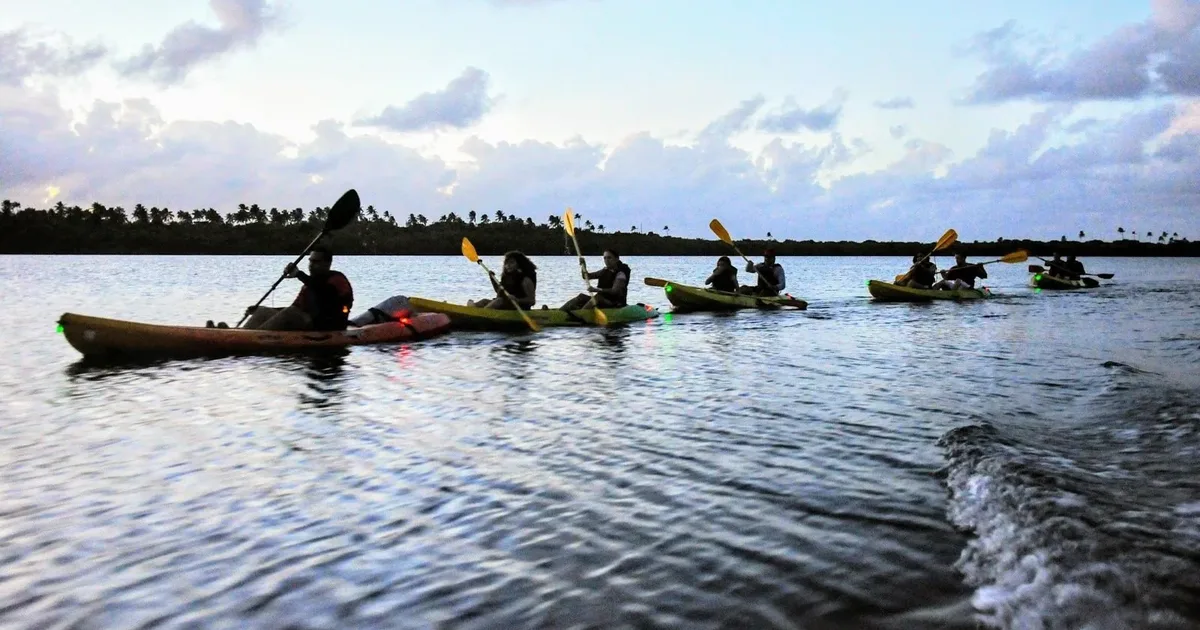
The first thing you notice in a Puerto Rican mangrove channel is the quiet. The wind drops, the water goes glassy, and the only sounds are your paddle, a heron lifting off and the tick of crabs on red mangrove roots arching overhead. Most visitors only see these forests in the dark, on the way into a bioluminescent bay. By daylight you see nursery water full of juvenile fish, pelicans diving off the cays and, if you’re lucky, a manatee surfacing for air.
For a first mangrove paddle, book a guided morning tour in La Parguera (from $50 with Kayaking Parguera) or a sunset bio bay paddle through the Laguna Grande mangrove channel in Fajardo (about $65–$85). Near San Juan, the cheapest real mangrove paddle is a rental from the nonprofit COPI in Piñones, at roughly $10–$15 an hour. This guide covers where to paddle across the island, which tours suit whom, and how to tell a red mangrove from a black one before your guide does.
Check Availability
Quick answer: where to paddle and what it costs
- Best overall: La Parguera’s mangrove channels and cays (Cayo Caracoles, Mata la Gata) give you the most mangrove per paddle stroke, plus the island’s only swimmable bio bay at night. Kayaking Parguera’s 3-hour Island Hopping tour is $50 plus a $3 DRNA fee.
- Easiest from San Juan: a sunset bio bay tour in Fajardo, which paddles about a mile of mangrove channel into Laguna Grande ($65–$85). The booking box above holds Puerto Rico Bio Bay Tours' Fajardo: Bioluminescent Lagoon Kayak or Full Moon Kayak Tour ($85, 4.6/5 from 275 reviews).
- Cheapest: rent a kayak from COPI in Piñones for roughly $10–$15 an hour and explore Torrecilla Lagoon’s red mangroves.
- Manatees: Condado Lagoon is your best chance, but it is an urban lagoon with little mangrove, and it had red-flag bacteria advisories from October 2025 to January 2026. Puerto Rico’s manatees number in the hundreds: USFWS’s 2023 stock assessment gives a minimum of 386 ± 89 (2010–2014 surveys), and DNER told the San Juan Daily Star in July 2026 that it estimates 500–600. Treat a sighting as a bonus.
- Do it right: paddle early, when the wind is calmer; wear reef-safe sun protection and long sleeves; never touch mangroves or manatees; and check 2026 conditions with your operator. Gilligan’s Island ferry service and some rental prices conflict across sources.
Our pillar guide to Puerto Rico’s bioluminescent bays and our bio bay kayak tours guide cover the night paddles in more depth.
What are mangroves, and why should you care before you paddle?
Mangroves are salt-tolerant trees that grow where land meets sea, and they are why Puerto Rico’s lagoons are full of fish, birds and, at night, glowing water. Their tangled roots trap sediment, soften storm waves, shelter baby fish, and keep the bio bays sheltered and rich in nutrients.
How much mangrove does Puerto Rico have?
Puerto Rico has roughly 7,800–8,300 hectares of mangroves (about 19,000–20,600 acres), depending on the method and year:
| Year | Area | Source |
|---|---|---|
| ~1800 | 11,791 ha (modelled original) | Martinuzzi et al. 2009, USDA Forest Service IITF |
| 1938 | 6,475 ha (low point, after a 45% decline) | Martinuzzi et al. 2009 |
| 2002 | 8,323 ha | Martinuzzi et al. 2009, citing the PR Gap Analysis map |
| ~2003 | ~7,920 ha | DRNA Forest Action Plan, citing Brandeis 2007 |
| 2023 | 7,784 ha (adjusted estimate) | García Vega, East Carolina University thesis |
What it means: loss, then recovery, then a new threat. Sugar-era agriculture wiped out nearly half the mangroves. Legal protection of all mangroves in 1972 allowed recovery, with mangrove cover up 12% between 1977 and 2002 (Martinuzzi et al.). Hurricane María (2017) caused the biggest recent setback. Mariela Victoria García Vega’s 2025 ECU thesis names María “the major driver of mangrove loss in Puerto Rico, with 65% of mangrove loss being associated with this disturbance,” and found that recovery was uneven. In Jobos Bay, illegal development kept some hurricane-cleared areas from regrowing.
Did Hurricane María destroy the mangroves you’ll paddle?
No, but it hit some areas much harder than others. A March 2025 Ecosphere study (Howe, Merchant, Hernández, Pessutti & Groffman, 16(3): e70226) found “greater damage in the Northeast Corridor site than in the La Parguera site.” La Parguera’s shorter, less urbanised mangroves recovered faster, and some sites now exceed their pre-hurricane vegetation health.
Restoration is ongoing. NOAA reports a $1.2 million National Coastal Resilience Fund grant for the Pozuelo mangrove project next to Jobos Bay NERR, 695 acres and growing, within a larger $3 million effort. NOAA Fisheries adds that The Ocean Foundation received $450,000 to plan and permit a further 750-acre project. On the northwest coast, UPR Aguadilla biology professor Robert J. Mayer told Mongabay (March 2022) that Vida Marina plans to restore 59 hectares (146 acres) of basin mangroves at Espinar Beach (Aguada), Jobos Beach/Secret Spot (Isabela) and the Finca Nolla Nature Reserve (Camuy).
Are mangroves protected by law in Puerto Rico?
Yes. Cutting, filling or damaging mangroves without permits can bring DRNA administrative fines of $500 to $50,000, according to statements by then-DRNA Secretary Anaís Rodríguez reported by Primera Hora. The legal framework DRNA cites includes:
- Law 23 of 1972 (DRNA Organic Act)
- Law 314 of 24 December 1998 (wetlands public policy)
- Law 241 of 1999 (New Wildlife Law)
- Law 133 of 1975 (Forests Law)
- Regulation 4860, which treats mangroves flooded by the tides as part of the public maritime-terrestrial zone
- Section 404 of the federal Clean Water Act
DRNA’s own visitor guidance is simple: don’t cut mangroves, don’t build fires that affect them, and don’t hang hammocks from them.
How do you identify Puerto Rico’s four mangrove species from a kayak?
You can learn all four in one paddle. Ceiba State Forest, Boquerón State Forest and Aguirre State Forest are documented as having all four.
| Species | Spanish | Where you’ll see it | Kayak ID tip |
|---|---|---|---|
| Red mangrove (Rhizophora mangle) | Mangle rojo | Right at the water’s edge, forming the tunnels you paddle through | Arching, spider-like prop roots; long, pencil-shaped seedlings dangling from branches |
| Black mangrove (Avicennia germinans) | Mangle negro | Just behind the red fringe, on muddier ground | Hundreds of finger-like pneumatophores poking up from the mud; leaves may show salt crystals |
| White mangrove (Laguncularia racemosa) | Mangle blanco | Higher, drier ground behind the black | Rounded, light-green leaves with two small glands at the base of the leaf blade; no dramatic roots |
| Button mangrove / buttonwood (Conocarpus erectus) | Mangle botón | The landward edge, often mixed with dry scrub | Button-like seed clusters; technically a mangrove associate, not a true mangrove |
Tip: the zonation is your map. Red grows in the water, then black, then white, then buttonwood as the ground rises. On Torrecilla Lagoon, red mangrove predominates, with white mangrove behind it (EcoTreasures, which kayaked it with COPI).
What wildlife will you see while mangrove kayaking in Puerto Rico?
Expect birds and fish almost every time. Turtles and manatees are lucky extras.
- Birds: brown pelicans, magnificent frigatebirds, herons and egrets, and royal terns, which EcoTreasures noted at the Torrecilla launch. Jobos Bay NERR has recorded 87 bird species, including about 28 migratory species (Caribbean Birding Trail).
- Fish: juvenile snapper and other reef fish shelter among red mangrove roots. Tarpon and stingrays turn up in Torrecilla (Island Activities).
- Upside-down jellyfish (Cassiopea): pulsing on the sandy bottom in calm, shallow mangrove water. Look, don’t touch: they can sting mildly.
- Crabs and invertebrates: mangrove tree crabs on roots, plus sponges and tunicates on submerged prop roots in La Parguera.
- Green iguanas: invasive in Puerto Rico and everywhere in coastal mangroves, often sunning on branches over the water. Río Espíritu Santo boat tours point out “big ones.”
- Sea turtles: more likely on seagrass beds near mangroves than inside channels. Culebra’s Luis Peña Channel Natural Reserve is the classic turtle paddle.
- West Indian (Antillean) manatee: federally threatened and listed as endangered by DRNA. The USFWS 2023 stock assessment estimates an average minimum of 386 ± 89 manatees island-wide (range 312–535; Nmin 318), based on aerial surveys from June 2010 to March 2014. DNER’s newer estimate, reported by the San Juan Daily Star in July 2026, is 500–600.
Can you kayak with manatees in Puerto Rico?
Yes, by watching from a distance. Condado Lagoon in San Juan is the most reliable spot, and Jobos Bay’s Mar Negro is important manatee habitat. In 2010, DRNA guidance reported by Primera Hora said it is prohibited to touch, chase, ride or swim within 150 feet of a marine mammal. Feeding manatees or giving them water can count as harassment, punishable by fines of up to $100,000, a year in prison, or both. Ignore any review bragging about “petting a baby manatee”: it is illegal and harms the animal.
Where is the best mangrove kayaking in Puerto Rico? Region by region
| Spot | Region | Real mangroves? | Best for | DIY rental? | Difficulty |
|---|---|---|---|---|---|
| La Parguera channels & cays | Southwest | Yes, extensive | Best overall, snorkelling, bio bay combo | Yes | Easy–moderate (wind) |
| Laguna Grande channel (Las Croabas) | Northeast | Yes, ~1-mile channel | Sunset + bio bay | No (tours only) | Easy |
| Piñones / Torrecilla Lagoon | San Juan metro | Yes | Budget, culture, birds | Yes (COPI) | Easy–moderate |
| Condado Lagoon | San Juan | Minimal | Manatees, skyline, clear kayaks | Yes | Easy |
| Humacao Nature Reserve | East | Yes (lagoons) | Families, cheap rentals | Yes | Easy |
| Jobos Bay NERR / Aguirre | South | Yes, extensive | Birders, solitude | Bring your own; check with reserve | Moderate |
| Vieques (Tres Palmitas, Mosquito Bay) | Islands | Yes | Day paddle + brightest bio bay | Limited | Easy |
| Culebra (Luis Peña) | Islands | Limited | Sea turtles | Tours | Easy–moderate |
| Gilligan’s Island (Guánica) | Southwest | Yes (mangrove cay) | DIY adventure, snorkel | Yes (call ahead) | Moderate (open water) |
| Río Espíritu Santo | Northeast | Yes, riverine | El Yunque views | Mostly pontoon tours | Easy |
| Laguna Tortuguero | North | Mostly freshwater | Bring-your-own paddlers | Ramp, no rentals confirmed | Easy, caimans |
The sections below run from San Juan outwards: the metro area, the northeast, the southwest, the south, the islands and the north coast.
San Juan metro: is there mangrove kayaking near San Juan?
Yes. Piñones and Torrecilla Lagoon, about 20 minutes east of the city, are the real mangrove option. Condado Lagoon is the convenient urban paddle with manatees.
Piñones & Laguna La Torrecilla (Loíza/Carolina): the budget mangrove paddle near San Juan
- What it is: according to DRNA’s 2009 Coastal Zone Management Program, the northeast coast holds the island’s most extensive mangrove forests, and “the Piñones mangrove forest is the most significant.” The community-run forest site calls it part of “the largest continuous natural system of mangroves in Puerto Rico.”
- Rentals: COPI (Corporación Piñones Se Integra) is a 501(c)(3) community
nonprofit founded in 1999. Its AcuaNatura kayak programme runs from the Centro
Cultural y Ecoturístico at the east end of the Boca de Cangrejos bridge (PR-187 km
4.2; tel. 787-253-9707).
- Price conflict: recent guides (On Me Travel; Puerto Rico Day Trips) list $10/hour, a Yelp photo shows $15/hour, and Paddling Magazine calls it a $10 donation. Budget $10–$15 and call ahead.
- Hours: On Me Travel lists 9 a.m.–5 p.m. daily, with the last rental at 4 p.m.
- Guided: COPI’s guided Torrecilla tours run about 2–3 hours (EcoTreasures) and weave in Afro-Puerto Rican history.
- Who it suits: the community-run paddle in the metro area, and the money stays in Piñones. Pair it with alcapurrias from the kiosks. Go in the morning: once the water cuts inland into dense mangrove, the breeze dies and the mosquitoes arrive (On Me Travel).
Condado Lagoon: manatees and clear kayaks, but few mangroves
- What it is: Condado Lagoon became Puerto Rico’s first estuarine nature reserve under Law 112 of 2013. Expect skyline views, seagrass, fish, turtles and frequent manatee sightings, but very little mangrove.
- Tours and prices:
- Glow Kayak Puerto Rico’s Nature Kayak Tour in clear tandem kayaks is $49 direct for adults (14+) and children (6–13), and lasts 45 minutes; kayak & snorkel starts at $89, and clear kayak/SUP rentals start at $30. On Viator it sells as the Clear Bottom Kayak Nature Tour in San Juan Condado Lagoon (from about $55, 5.0/5 from 16 reviews, a small sample).
- LED Night Kayak & SUP’s 1-hour Clear Kayak Tour in Condado Lagoon is $65 (4.9/5 from 1,640 Viator reviews), a morning paddle before the lagoon gets busy.
- Parking: Glow Kayak points guests to the Hilton Garden Inn garage at a special $8 rate for up to 3 hours.
- Water quality warning: the San Juan Bay Estuary Program posts weekly flags. Condado Lagoon had red flags (enterococci over the EPA Beach Action Value of 70 CFU/100 mL) for samples in October 2025, December 2025 and January 2026. 2026 updates (March, August, September) showed green flags, but some spots were still over the limit. Paddling is fine; skip the swim after heavy rain, and check estuario.org before snorkelling.
- More day trips from the capital are in our best excursions and day trips from San Juan, and night trips to the glowing water in our guide to bio bay tours from San Juan.
Caño Martín Peña & Laguna San José
These are part of the same San Juan Bay estuary. You see them best through community-led initiatives such as the ENLACE project; they are not set up for a casual tourist paddle.
Northeast: Fajardo, Humacao and Río Grande
Fajardo: Las Croabas & the Laguna Grande mangrove channel
The famous bio bay route is a mangrove paddle first. Tours follow roughly a 1-mile mangrove channel (Island Kayaking Adventure) inside the Las Cabezas de San Juan Nature Reserve into Laguna Grande. Book the earliest (sunset) departure to see the mangroves in daylight. One Tripadvisor reviewer (June 2026) said exactly that: “you can see the wildlife and trees while kayaking to the lagoon whereas in the dark you can’t see much at all.”
| Operator | Price | Duration | Min age | Notes | Book online |
|---|---|---|---|---|---|
| Pure Adventure | $66.90–$67 | 2 hrs | 6 | Marine biologist guides; tandem kayaks; weight limit listed as 220 lb on Expedia and 240 lb on Viator (conflict) | Fajardo: Bioluminescent Bay Kayak Tour in Puerto Rico ($65, 4.1/5, 52 reviews) |
| Island Kayaking Adventure | From $65 | 1.5 hrs | 6 | In business since 1998; minimum 6 guests | Direct only |
| Paradise Seekers | $85 self-drive; $145 with pickup | — | 7 | Kayak 101 lesson included | Direct only |
| Access Tours PR | From $65 | ~2 hrs | 6 or 7 (site conflicts) | Groups up to 30 | With San Juan transport: San Juan: Bioluminescent Laguna Grande Bay Night Kayaking ($125, 4.4/5, 95 reviews) |
Two more Laguna Grande paddles through the same channel sell on GetYourGuide: Puerto Rico Bio Bay Tours’ lagoon kayak or full moon kayak tour ($85, 4.6/5 from 275 reviews) and Kayaking Puerto Rico’s Fajardo: Bio Bay Kayak Tour ($72, 4.3/5 from 310 reviews).
- Daytime only: the 3-hour Fajardo Guided Kayak & Snorkeling Tour at Cabezas de San Juan starts at $69 (4.7/5 from 95 Viator reviews).
- Deep dive: Laguna Grande, Fajardo bio bay.
Humacao Nature Reserve (Punta Santiago): the cheap family paddle
- What it is: a DRNA reserve of 3,186 cuerdas (about 3,094 acres), established in 1986, protecting Pterocarpus forest, lagoons and mangroves. It sits on PR-3 km 74.3, just west of Punta Santiago.
- Rentals: Water Sports and Eco-Tours rents kayaks, paddleboards and pedal boats. The operator itself posted $15 per person per hour (2016), and Tripadvisor reviewers paid $15/hour in recent years. One older blog lists $10. Kayaks stay in the lagoons (Mandri, Santa Teresa).
- Hours conflict: the reserve opens around 7 a.m.–3 p.m. (Tripadvisor reviewer), but rentals have been reported closed Monday and Tuesday. ZeePuertoRico lists Wednesday–Sunday and holidays, 9 a.m.–5 p.m. Call 787-852-6058.
- Who it suits: families. Flat water, free entry and parking, and iguanas and wading birds everywhere. Don’t swim at the reserve’s beach.
Ceiba State Forest
This 352-acre forest is mostly mangrove, has all four species, and has manatees in the surrounding waters. It suits birders, but we found no established kayak rental there.
Río Espíritu Santo (Río Grande)
- A mangrove-lined river with El Yunque views.
- The main operator, La Paseadora, runs pontoon boat tours, not kayaks: from $25–$26, 1 hour 45 minutes, up to 15 people, departing 9 a.m., 11 a.m., 1 p.m. and 3 p.m.
- Las Tortugas Adventure has historically offered a downstream eco-kayak tour to Bahía Beach. Confirm it is still running before you plan around it.
Southwest: La Parguera, Guánica, Boquerón & Cabo Rojo
La Parguera: the best mangrove kayaking in Puerto Rico overall
- Why: dozens of mangrove cays and channels (“Canales de la Parguera”) in calm, clear water, a healthier post-María recovery (Howe et al. 2025), and La Parguera’s bio bay at night. See our La Parguera bio bay guide.
- Kayaking Parguera Tours (licensed by the Puerto Rico Tourism Company and DRNA;
founded 2015; open Wednesday–Sunday; book direct):
- Island Hopping Kayak Tour: $50 for adults and children aged 4–10. It lasts 3 hours, departs at 8 a.m., and adds a $3 DRNA fee. One child (4–10) can ride in the middle of a tandem.
- Hobie Pedal Adventure (Cayo Caracoles, Majimo sandbar, La Gata cay): $65 at 8 a.m., $99 at 11 a.m., 3 hours, limited to 6 tandem kayaks.
- Weight conflict: the same page lists both 275 lb and 250 lb per seat.
- Self-guided: Kayaking Parguera rents singles, doubles and triples (ID, contract and reservation required). It warns that you’ll paddle against the current half the time.
- Boat + kayak: Aventuras Tropicales' La Parguera Boat Tour ($80, 4.8/5 from 99 Viator reviews) spends 3 hours at Cayo Caracoles and Rabo de la Gata with kayaks, snorkel gear and snacks, departing at 10 a.m. from Punta Papayo.
- Pedal instead of paddle: Caribbean Chiliboats' La Parguera: Water Bike Tour in La Parguera Cays ($85, 4.9/5 from 20 reviews, a small sample) covers the same cays on a pedal catamaran.
- Timing: take the 8 a.m. slot. The trade winds build through the day, which is why the 11 a.m. pedal tour costs $34 more.
Guánica: Gilligan’s Island (Cayo Aurora) kayak
- Status is unclear, so plan for DIY. Cayo Aurora is a mangrove cay about 600 m
from Punta Jacinto, inside the Guánica Biosphere Reserve.
- The 2020 earthquakes damaged its dock and caused the land to sink. Several sources (Vámonos Tours, Tripadvisor reviewers in 2023, West Indies Travel) say the ferry stopped and the island is “officially closed,” though you can still visit by your own kayak.
- Other guides still list a Tuesday–Sunday water taxi at about $9.59 round trip.
- Rentals: as of January 2024, Copamarina Beach Resort charged $35 for the first hour in a single and $40 in a double, then $15 per additional hour (An Apple a Plane). Rentals may be limited to resort guests when the resort is busy, so call ahead.
- Who it suits: confident paddlers. It is a beautiful mangrove-and-snorkel paddle on a calm morning, but it is open water. Skip it on windy days.
Boquerón & Cabo Rojo
Boquerón State Forest, one of Puerto Rico’s oldest (proclaimed 1918), protects mangroves at Puerto Real, Boquerón, Llanos Costa and Bahía Montalva, with all four species and a mangrove boardwalk. We could not verify a current dedicated mangrove kayak operator for 2026. Ask locally in Boquerón village.
South: Jobos Bay & Salinas
Jobos Bay National Estuarine Research Reserve (Salinas/Guayama)
- What it is: a 2,883-acre NOAA/DRNA reserve designated in 1981 (NOAA fact sheet), covering mangroves, salt flats, lagoons and the Cayos Caribe cays. It sits in Puerto Rico’s second-largest estuary and is an Important Bird Area, home to the endangered yellow-shouldered blackbird and Puerto Rican plain pigeon.
- Paddling: Mar Negro’s mangrove lagoons are superb for solitude. DRNA planning documents reference kayak-launch parking. DNER Administrative Order 2026-05, effective July 13, 2026, banned jet skis in Mar Negro to protect manatees. Under Law 430-2000, fines run up to $5,000 per incident, and each day a violation continues counts as a separate offence (San Juan Daily Star).
- Caveat: we found no 2026 outfitter renting kayaks at the reserve. Call the visitor centre before you go, or bring your own boat.
- Next door: Aguirre State Forest (about 2,393 acres of mangroves and salt ponds) allows kayaking in designated areas.
Islands: Vieques & Culebra
Vieques: mangrove kayaking by day, brightest bio bay by night
- Black Beard Sports daytime kayak/SUP tour: Tres Palmitas, a calm, mangrove-ringed bay in the Vieques National Wildlife Refuge. $75 + tax, 9 a.m. only, about 2.5 hours in total with about 1 hour on the water, minimum age 5. Book direct.
- Abe’s Snorkeling Mangrove Kayak Tour: mangrove tunnels and lagoons around Mosquito Bay, from $70, 2 hours, all levels. Book direct.
- Night: Black Beard’s clear-bottom bio bay tour has a maximum of 10 guests, a 400 lb limit per kayak and a minimum age of 5, and you must stay overnight on Vieques. Booking online instead, Salty Spirit’s Vieques: Bioluminescent Bay Full Clear Kayaking ($112, 4.7/5 from 108 reviews) also needs an overnight stay.
- Plan with how to get to Vieques and our Mosquito Bay, Vieques guide.
Culebra: kayak to the sea turtles
- Kayaking Puerto Rico’s Culebra Aquafari paddles across the Luis Peña Channel Natural Reserve from Tamarindo Beach to snorkel with green sea turtles. The half day is from $69 (2.5 hours) direct. The full-day version with ferry tickets from Ceiba sells on Viator as the Culebra Snorkel with Turtles & Flamenco Beach Adventure by Ferry (from about $146, 4.7/5 from 1,531 reviews).
- Mangroves? This is a turtle and seagrass paddle, not a mangrove tour. We couldn’t verify a current guided mangrove tour in Culebra’s Puerto del Manglar or Ensenada Honda.
North: Laguna Tortuguero, and are there caimans?
Yes. Laguna Tortuguero (Vega Baja/Manatí) holds one of Puerto Rico’s largest populations of introduced spectacled caimans. It is a mostly freshwater lagoon, not a classic mangrove paddle. It has a free kayak ramp and is open Wednesday–Sunday, roughly 7 a.m.–3:30 p.m. (ZeePuertoRico). Swimming isn’t recommended, and El Nuevo Día reported a caiman bite at the nearby Manantial spring. Paddle in daylight and keep your hands out of the water.
Mangrove kayak operators in Puerto Rico compared (2026)
| Operator | Location | Type | 2026 price | Duration | Min age | Group / limits | Notes | Book online |
|---|---|---|---|---|---|---|---|---|
| Kayaking Parguera | La Parguera | Guided mangrove/cays; Hobie pedal; rentals | $50; pedal $65/$99 | 3 hrs | 4 | 6 tandems on pedal tour | +$3 DRNA fee; Wed–Sun | Direct only |
| Aventuras Tropicales | La Parguera | Boat + kayak + snorkel at the cays | $80 | 3 hrs | — | — | 10 a.m. from Punta Papayo | La Parguera Boat Tour (Viator, 4.8/5, 99 reviews) |
| COPI | Piñones | Rentals + guided lagoon tours | ~$10–$15/hr | 2–3 hrs guided | — | — | Nonprofit; price conflict | Direct only |
| Glow Kayak PR | Condado Lagoon | Clear kayak nature tour; snorkel; rentals | $49; snorkel $89; rentals from $30 | 45 min | 6 | Small group | Not mangrove; manatees likely | Clear Bottom Kayak Nature Tour (Viator, 5.0/5, 16 reviews) |
| LED Night Kayak & SUP | Condado Lagoon | Clear kayak (day & LED night) | $65 | 1 hr | — | — | Skyline views | Clear Kayak Tour in Condado Lagoon (Viator, 4.9/5, 1,640 reviews) |
| Pure Adventure | Fajardo | Sunset/night bio bay via mangrove channel | $66.90–$67 | 2 hrs | 6 | Tandems; 220–240 lb limit | Marine biologist guides | Bioluminescent Bay Kayak Tour (4.1/5, 52 reviews) |
| Island Kayaking Adventure | Fajardo | Bio bay via mangrove channel | From $65 | 1.5 hrs | 6 | Min 6 guests | Since 1998 | Direct only |
| Paradise Seekers | Fajardo | Bio bay | $85 / $145 w/ pickup | — | 7 | — | Kayak 101 included | Direct only |
| Water Sports and Eco-Tours | Humacao Reserve | Kayak/SUP/pedal-boat rentals | ~$15/person/hr | Hourly | — | — | Closed Mon–Tue (reported) | Direct only |
| Black Beard Sports | Vieques | Daytime kayak/SUP; clear bio bay | $75 + tax (day) | ~2.5 hrs | 5 | Max 10 (bio bay) | Overnight stay required for night tour | Direct only |
| Abe’s Snorkeling | Vieques | Mangrove kayak tour | From $70 | 2 hrs | — | — | Mosquito Bay tunnels | Direct only |
| Kayaking Puerto Rico | Culebra | Kayak + turtle snorkel | From $69 | 2.5 hrs | — | — | Seagrass/turtles, not mangroves | Full day with ferry: Culebra Aquafari (Viator, 4.7/5, 1,531 reviews) |
| Copamarina Beach Resort | Guánica | Kayak rental to Gilligan’s | $35–$40 first hr (Jan 2024) | Hourly | — | — | Call ahead | Direct only |
| La Paseadora | Río Grande | Pontoon river tour (not kayak) | From $25 | 1 hr 45 min | All ages | Up to 15 | Thu–Sun | Direct only |
Prices are as listed on operator or booking pages viewed for this October 2026 update. Taxes and fees vary, so confirm before booking.
When is the best time for mangrove kayaking in Puerto Rico?
Early morning, on any day of the year. The water is calmest and wildlife most active before the trade winds build. Kayaking Parguera recommends early mornings and charges $34 more for its 11 a.m. pedal tour than for the 8 a.m. slot. For the bio bay combo, take the sunset departure. Moon phases and seasons for the night paddles are in our best time to see the bioluminescent bay guide.
- Tides and wind: in La Parguera, rentals start upwind, so you paddle against the current half the time. Save energy for the return.
- Rain: after heavy rain, lagoon bacteria spike. Avoid swimming in Condado for a day or two and check the Estuary Program flags.
- Hurricane season (June–November): tours cancel for weather. Book with flexible cancellation.
Is mangrove kayaking in Puerto Rico safe?
Yes, for most people on flat-water tours with a life jacket. The real risks are sun, wind, bacteria and, in one lagoon, caimans.
- Sharks: not a realistic concern in shallow mangrove channels.
- Caimans: only a concern at Laguna Tortuguero and nearby freshwater (see above).
- Water quality: Condado has had red flags (2025–2026). Don’t swim with open cuts.
- Open water: Gilligan’s Island and the La Parguera cays get choppy in the afternoon wind.
- Weight limits: typically 220–275 lb per seat. Pure Adventure weighs guests.
What should you wear and bring?
- Long-sleeve UPF shirt, hat and polarised sunglasses (polarised lenses let you see fish and roots below the surface)
- Reef-safe sunscreen; water shoes for La Parguera cay landings (Kayaking Parguera recommends them)
- Insect repellent for mangrove mosquitoes and no-see-ums on daytime paddles. If you’re continuing into a bio bay, follow your operator’s rules: many ask guests to minimise lotions and sprays before entering the water.
- Dry bag, water, cash for DRNA fees and kiosks, and a phone on a lanyard
Clear kayak vs. regular kayak vs. paddleboard in the mangroves?
Clear kayaks work best in Condado and over La Parguera’s seagrass in good light. In murky lagoons or narrow red mangrove tunnels, a standard sit-on-top shows you as much and is easier to steer. Paddleboards give a great view over shallow water (Piñones, Vieques’ Tres Palmitas) but are harder work in wind. See clear kayak vs. kayak vs. electric boat.
Can kids do mangrove kayaking?
Yes. Minimum ages run from 4 (Kayaking Parguera, riding mid-tandem) to 5 (Black Beard, Vieques), 6 (most Fajardo and Condado tours) and 7 (Paradise Seekers). For young kids, Humacao’s lagoon rentals and Condado’s 45-minute tours are the easiest choices.
Should you rent or take a guided tour?
Rent if you’re a confident paddler in sheltered water (COPI in Piñones, Humacao, Condado). Go guided for Laguna Grande (tours only), for La Parguera’s cays if you’re new, and anywhere with open-water crossings. Guides also find wildlife you would paddle right past.
Can you combine mangrove kayaking with a bio bay?
Yes, and it makes a full day:
- Fajardo: a sunset tour through the mangrove channel into Laguna Grande. The easiest from San Juan.
- La Parguera: an 8 a.m. mangrove kayak, an afternoon rest, then a night bio bay boat and swim.
- Vieques: Black Beard’s 9 a.m. Tres Palmitas mangrove paddle, then Mosquito Bay at night.
Compare operators in best bio bay tours compared and read why bio bays glow and whether you can swim.
Mangrove etiquette: leave no trace
- Don’t grab, break or tie up to mangrove roots or branches. DRNA asks visitors not to cut them, hang hammocks or light fires.
- Don’t stand on seagrass or coral, and don’t collect shells or marine life (Kayaking Parguera prohibits collecting).
- Stay at least 150 feet from manatees, per 2010 DRNA guidance, and never feed or touch them.
- Pack out everything, including fishing line.
FAQ
Where is the best mangrove kayaking in Puerto Rico? La Parguera, on the southwest coast. It has calm, clear water, dozens of mangrove cays, a healthy post-María recovery, guided tours from $50, and a bio bay for the same night. Fajardo’s sunset mangrove channel is the best option within about an hour of San Juan.
Can you see manatees while kayaking in Puerto Rico? Often in Condado Lagoon, sometimes in Jobos Bay and Ceiba, never guaranteed. USFWS gives a minimum of 386; DNER estimated 500–600 in July 2026. Keep 150 feet away and never touch or feed them.
Is mangrove kayaking in Puerto Rico safe? Yes, on guided flat-water tours with life jackets. Watch for afternoon wind, sun exposure, post-rain bacteria in urban lagoons like Condado, and caimans at Laguna Tortuguero.
Do I need kayaking experience? No. Most tours include a briefing and use stable tandem sit-on-tops. Pedal kayaks (Kayaking Parguera’s Hobie tour) are easier still. Open-water crossings, like Gilligan’s Island, suit confident paddlers.
How much does a mangrove kayak tour cost in Puerto Rico? Rentals run about $10–$40 per hour. Guided tours cost about $49–$99 per person: Condado ($49), La Parguera ($50–$99), Fajardo ($65–$85) and Vieques ($70–$75), plus taxes or a $3 DRNA fee.
What’s the best time of day to kayak the mangroves? Early morning, when the water is calmest and wildlife most active. For bio bay combos, book the sunset departure so you see the mangroves in daylight.
Can I rent a kayak and go alone? Yes, in Piñones (COPI), Humacao Nature Reserve, Condado Lagoon, La Parguera and Guánica. Laguna Grande in Fajardo is tours-only. Always tell someone your route.
Are there caimans in Puerto Rico? Yes. Introduced spectacled caimans live in Laguna Tortuguero (Vega Baja/Manatí) and nearby freshwater. They aren’t in saltwater mangrove bays like La Parguera or Piñones.
Can kids go mangrove kayaking? Yes. Minimum ages range from 4 (Kayaking Parguera) to 5 (Vieques’ Black Beard) to 6–7 (Fajardo and Condado). Humacao’s lagoon rentals are the most kid-friendly.
Is a clear kayak worth it? In Condado and over La Parguera’s seagrass on sunny days, yes. In murky lagoons or tight mangrove tunnels, a regular kayak sees nearly as much and steers better.
What should I bring? A long-sleeve sun shirt, hat, polarised sunglasses, reef-safe sunscreen, water shoes, water, a dry bag, cash for fees, and repellent (unless you’re entering a bio bay that asks you to skip it).
What’s the biggest mangrove forest in Puerto Rico? Piñones, east of San Juan. DRNA calls it the most significant mangrove forest on the northeast coast, the island’s most mangrove-rich coast, and it is part of Puerto Rico’s largest continuous mangrove system.
Ready to paddle? The Laguna Grande channel is the easiest mangrove trip to book from San Juan; check dates for our pick below.
See the Water Light Up
Paddle into Laguna Grande with the operator 275 guests rated 4.6/5 — small groups, a full safety briefing, and free cancellation up to 24 hours before.
Check Availability & Book