Mosquito Bay, Vieques: The Complete Guide to the World's Brightest Bio Bay
Mosquito Bay on Vieques is the Guinness-rated brightest bio bay. 2026 prices for every operator, kayak vs clear kayak vs electric boat, full-moon closures and where to stay.
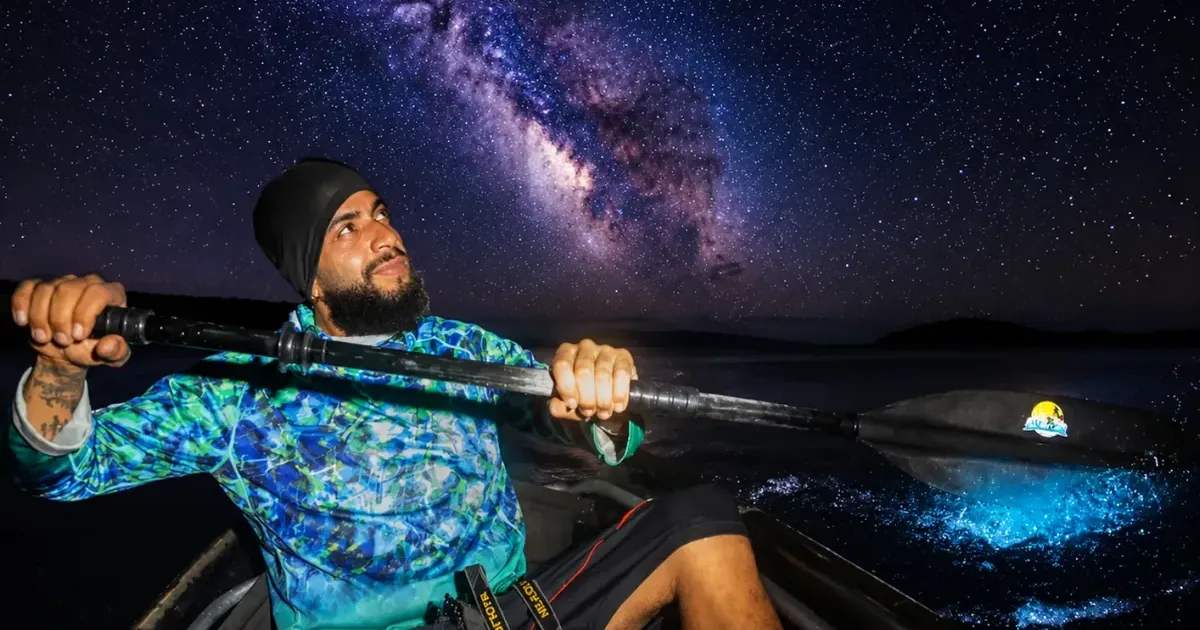
You drag a paddle through black water and it leaves a comet’s tail of blue-white light. A fish shoots under your kayak like a streak of lightning, and drips fall from your fingertips like sparks. This is Mosquito Bay (Puerto Mosquito) on the south coast of Vieques, which Guinness World Records names the brightest bioluminescent bay on the planet. Getting here takes more effort than Puerto Rico’s other two bio bays: a ferry or small plane, a bumpy dirt road and, for most people, a night on the island. On a dark night it repays every bit of that. Below: how to pick a Mosquito Bay tour, when to go (the moon matters more than the season), what it costs in 2026, and the rules that keep the glow alive.
Prices were checked on operator sites and booking platforms in September and October 2026. They change often, so confirm when you book.
Status, checked October 25, 2026: the glow at Mosquito Bay has been very dim since late September 2026, when the weekly plankton counts of the Vieques Conservation and Historical Trust fell to zero, and scientists and the DRNA are looking for the cause. Earlier blackouts, in 2014 and after Hurricane María in 2017, recovered. Ask your operator about the recent glow before you book; Laguna Grande and La Parguera are not affected by this report.
Check Availability
Mosquito Bay at a glance
- What it is: Mosquito Bay (Puerto Mosquito, Bahía Bioluminiscente) is a small, mangrove-ringed bay about 2 miles east of Esperanza on Vieques’ south coast. Guinness World Records lists it as the brightest bioluminescent bay in the world (record year 2006; many sites say 2008, which most likely refers to the printed 2008 edition).
- Why it glows: up to 700,000 dinoflagellates per gallon (Guinness). A narrow mouth keeps them in, and the mangroves feed them.
- How to see it: only on a tour with a DRNA-permitted operator, between 6 PM and midnight. Choose a standard kayak (from $70), a clear kayak ($53–$72) or an electric boat ($85 direct).
- Closures: the night before, the night of and the night after every full moon. No tours run on those nights.
- Rules: no swimming, no DEET or sunscreen, no flash.
- Our advice: stay overnight on Vieques. The same-day option from San Juan ($200–$230 packages) depends on the late ferry running. If you already know you want to book, our Mosquito Bay kayak tours page lists the tours you can reserve online.
What and where is Mosquito Bay?
Mosquito Bay is a shallow, mangrove-lined bay on the south coast of Vieques, about 2 miles east of the village of Esperanza. It sits inside the Reserva Natural Bahía Bioluminiscente de Vieques, which Puerto Rico’s Department of Natural and Environmental Resources (DRNA) co-manages with the Vieques Conservation & Historical Trust (VCHT).
Vieques itself is a 52-square-mile island (Smithsonian) about 7–8 miles off Puerto Rico’s east coast. Locals call it “Isla Nena.” Much of it is protected as the Vieques National Wildlife Refuge.
Key facts at a glance
| Fact | Detail | Source / note |
|---|---|---|
| Official names | Puerto Mosquito; Bahía Bioluminiscente de Vieques | DRNA reserve name |
| Location | South coast of Vieques, about 2 mi east of Esperanza | Lonely Planet |
| Brightness record | “Brightest bioluminescent bay,” record year 2006 | Guinness World Records page |
| Concentration (record) | Up to 700,000 dinoflagellates per gallon (GWR uses a 4.5 L gallon) | Guinness |
| Organism | Pyrodinium bahamense (“whirling fire”) | Guinness |
| Federal designation | National Natural Landmark, 1980 | NPS NNL site list |
| Management | DRNA, with VCHT as co-manager since a 2016 agreement | VCHT |
| Depth | Mostly about 3 ft, deepest about 13 ft | PuertoRico.com (resident writer); not confirmed by a scientific source |
| Size | About 160 acres (bay) | Island Journeys; treat as approximate |
| Name origin | Legend says it is named after El Mosquito, a ship of the pirate Roberto Cofresí | NPR, PBS NOVA (legend) |
Why is Mosquito Bay so bright?
Geography plus food. Guinness puts it simply: Mosquito Bay is the brightest because “its narrow mouth prevents the dinoflagellates from being washed out to sea, and decaying mangrove swamps provide them with plentiful food.”
Three things work together:
- A narrow, winding mouth. The S-shaped channel limits exchange with the open sea, so the plankton stay concentrated. VCHT says the mangroves at the mouth give it “its characteristic meandering shape, which in turn, protects the Pyrodinium bahamense bloom from washing out into the sea.”
- Red mangroves. Decaying mangrove matter supplies nutrients. NPR’s 2017 reporting quotes bioluminescence scientist Edith Widder saying the mangroves “provide an essential vitamin to the dinoflagellates.”
- Darkness. Vieques has little light pollution. VCHT monitors light levels and runs education on light-pollution control as part of its co-management duties.
Each P. bahamense cell flashes blue-green “for about one-tenth of a second” when agitated (Guinness). Scientists think the flash is a defense mechanism that startles predators or draws bigger predators toward whatever is disturbing the plankton (Widder, via NPR).
How many dinoflagellates are in the water?
You will see very different numbers online. The only one with an official stamp is Guinness’s “up to 700,000 per gallon.” Here is how the claims compare:
| Figure | Who says it | How much to trust it |
|---|---|---|
| Up to 700,000 per gallon (record year 2006) | Guinness World Records | Official record figure |
| About 100,000 per liter (2017, pre-María) | CNN, 2019 | Reported sampling data |
| Nearly 600,000 per liter (June 2018 spike) | CNN, 2019 | Reported sampling data |
| About 2.4 million per gallon (2018) | Living Wilderness blog, 2018 | Secondhand; unverified |
| Over 3 million per gallon (March 2019 “record”) | Going.com, quoting VCHT’s Mark Martin Bras | Secondhand quote; no published dataset found |
| 1–2.1 million per gallon “average” | Science Times (2024), operator sites | Unsourced; use with caution |
| “Up to 160,000 per liter” | Quoted on Vieques.com and older sites | Older figure; origin unclear |
600,000 per liter works out to well over 2 million per US gallon, so the post-María figures broadly agree with one another, but they do not come from a single published dataset. We treat “Guinness-certified up to 700,000 per gallon” as fact, and the higher post-2018 counts as figures reported by VCHT researchers and guides.
History and conservation: how did Mosquito Bay survive?
Vieques before tourism
For about six decades the U.S. Navy used much of Vieques for training and bombing exercises, until it left in 2003. Large parts of the former Navy land are now the Vieques National Wildlife Refuge, and some areas are still closed while unexploded ordnance is cleared. One accidental side effect of that history is that the south coast stayed largely undeveloped, which helps explain why the bay still has dark skies and intact mangroves.
When did swimming stop?
Swimming is banned and enforced today. A Vieques Blog post dated September 16, 2011 was headlined “No se puede nadar en la Bahía Bioluminiscente de Vieques” (“Swimming is prohibited in the bio bay”). A TripAdvisor review from April 12, 2013 said “swimming is now prohibited… As many as 200 people or more visit per night.” Abe’s Snorkeling, a permitted operator, explains that DRNA “no longer allows swimming in Bahía Mosquito in order to minimize human contamination from products like mosquito repellent containing DEET and sunscreens.” We could not find the original DRNA order with an exact date, so treat “around 2011” as approximate.
The 2014 dimming
The Associated Press reported in April 2014 that “the bay went dark in early January because of rough seas.” DRNA Secretary Carmen Guerrero said it was “unclear why the glow diminished again” that spring and was “reaching out to local and international scientists to launch an investigation.” Tour operators lost business: Black Beard Sports estimated it had “lost about 400 tourists,” and an Abe’s guide reported “about a 40 percent loss in clients.” Officials planned to “boost vigilance” against unauthorized tour companies. The glow returned that fall, and the episode was a key reason the rules got stricter.
Did Hurricane María ruin Mosquito Bay?
No, although for a while it looked as if it might. Hurricane María struck Puerto Rico on September 20, 2017. Freshwater runoff, wind that may have pushed water out of the bay’s mouth, and the loss of the mangroves all knocked the glow down.
The recovery, in order:
- December 2017 (NPR): the bay “was dark” for weeks after the storm. A guide rated the returning glow at “perhaps a two on a 10-point scale.”
- 2018 (PBS NOVA): Mosquito Bay recovered much faster than Fajardo’s Laguna Grande.
- About 8–9 months after María: Abe Velasquez of Abe’s Snorkeling paused tours for “nearly nine months” (CNN, 2019). VCHT’s Mark Martin Bras said the bay “came back about eight months after the hurricane” (Smithsonian, 2022).
- June 2018: P. bahamense spiked to nearly 600,000 per liter (CNN, 2019).
- March 2019 (EDF): dinoflagellates “have returned in numbers exceeding pre-storm levels.”
- 2022 (Smithsonian): Bras reported “a steady increase in the abundance of the organisms, setting several records.”
One source disagrees: a UC San Diego Latz Lab blog post from October 30, 2017 said Mosquito Bay’s bioluminescence had “recovered.” NPR’s on-the-water reporting in December 2017 described a much weaker glow, and we go with NPR’s later, first-hand account.
What does the bay look like in 2026?
Healthy and bright on dark nights, going by 2025–2026 traveler reviews and operator reports. We found no 2025–2026 news of a new darkening event. VCHT reports its plankton counts to DRNA every year, but we could not find a public 2025–2026 dataset, so “brighter than ever” claims in operator marketing are anecdotal. Sargassum is a recurring problem on Caribbean beaches, but we found no credible reporting that it has affected brightness inside Mosquito Bay. Treat social-media claims either way with caution.
What threatens the bay now?
- Light pollution from new construction along the Esperanza–Isabel II road and in Esperanza.
- Runoff and sedimentation from unpaved roads and heavy rain. VCHT works on erosion control.
- Stronger storms and climate change. María showed how fast mangrove loss can knock the glow out.
- Visitor pressure: chemicals on skin, unpermitted operators, and crowding at the launch site.
Who protects Mosquito Bay?
The Vieques Conservation & Historical Trust (VCHT), founded in 1985, is the bay’s scientific guardian. Under a 2016 co-management agreement with DRNA, VCHT runs plankton counts, water-quality monitoring, light-pollution monitoring and a research database, and it reports to DRNA every year. After María caused “almost total mortality of the mangroves” at the bay’s mouth (VCHT), the trust launched a mangrove project. A NOAA-funded restoration with VCHT, DRNA and partners laid 4,000 biodegradable “living shoreline bags” and reports an 84% success rate for planted mangroves. Visit VCHT’s center in Esperanza (museum, small aquarium and Biobay room) before your tour, and check current hours with the trust directly.
Kayak, clear kayak or electric boat: which Mosquito Bay tour is best?
For most people, a small-group clear-kayak tour is the best value. Pick the electric boat if paddling is a problem, and Abe’s standard kayaks if you want the most experienced guiding. Our island-wide clear kayak vs kayak vs electric boat guide adds Fajardo and La Parguera. Here is how the formats compare (prices checked September–October 2026; always confirm when you book):
| Tour type | On-water time / total | 2026 price range (per adult) | Min age | Weight limits | Group size | Physical level | Best for |
|---|---|---|---|---|---|---|---|
| Standard kayak (Abe’s, Vieques Kayaks) | About 1–1.5 hr / 2 hr | $60–$70 | Abe’s: all ages (infants free); Vieques Kayaks: 5+ (per booking platforms) | Ask operator | Larger groups possible; Abe’s uses up to 5 guides | Easy–moderate; sit-on-top tandems | Guide quality, history buffs, traditionalists |
| Clear-bottom / clear kayak (Black Beard, JAK, Aqua Sunset, Mosquito Bio Bay Tours, Dindin’s, Bieque Eco Trips, Tropical Reef, Taino Aqua) | About 1 hr / 1.5–2.5 hr | $53–$72 | Usually 4+ or 5+ | Black Beard: 400 lb combined per kayak; Aqua Sunset: 250 lb per person | 10 (Black Beard) up to 20 (Mosquito Bio Bay Tours) | Easy–moderate | Couples, families, watching the glow under you |
| Clear canoe (Adventure Vieques) | 1.5 hr | $57 + $8 paid on site | 4–99 | Ask operator | Max 20 | Easy | Budget travelers |
| Electric boat (Isla Nena, 24-ft electric catamaran) | 40 min | $85 + $3 DRNA fee in cash | All ages | n/a | Min 6 to run | None | Seniors, limited mobility, non-paddlers |
| Day trip from San Juan (e.g., iVentures Caribbean) | About 1 hr paddle / 10–12 hr total | $200 (own site) to $230 (booking platforms) | 4+ | 380 lb combined per kayak | Min 6 to run | Moderate (long day) | Travelers who can’t spare a night |
| Kayaking Puerto Rico Vieques trip (by boat from Fajardo) | About 7 hr total | $195 + taxes and fees | 10+ | Ask operator | Optional San Juan transport needs 6 guests | Moderate (long evening) | Mainland-based travelers who want Vieques without the ferry |
Our pick on GetYourGuide for a clear kayak is the Vieques: Bioluminescent Bay Full Clear Kayaking tour ($112, 4.7/5 from 108 reviews). For the electric boat, GetYourGuide sells the Vieques: Bioluminescent Bay Boat Tour through Borikua Tours (from $105, 4.5/5 from 54 reviews), which costs more than Isla Nena’s $85 direct price.
The Kayaking Puerto Rico trip works differently from the rest: it leaves by boat from Marina Puerto Chico in Fajardo between 4:30 and 5:30 PM depending on the month (5:30 PM in July–August, 5:00 PM in September–November, 4:30 PM in December–January), so you never touch the ferry. The operator does not publish a return time, so plan for a late night.
Is there a pontoon option? No. Isla Nena’s electric catamaran is the only powered vessel we found operating on the bay in 2026, and gas engines are not allowed. An older electric boat run by Island Adventures was damaged in the hurricanes.
Clear kayak vs. regular kayak: is clear worth it?
Usually yes, but it matters less than the moon, the group size and the guide. Clear hulls let you watch the glow swirl beneath you, and fish show up as streaks of light. Some reviewers say the effect is subtler than the photos suggest. One July 2026 Viator reviewer wrote that the organisms “aren’t very visible” except under the hull and around the paddles. Others prefer Abe’s “normal kayaks instead of clunky glass bottoms.” The glow comes from movement, so your paddle and hands produce most of the show whatever the hull. Our bio bay kayak tours guide covers the paddling side in more depth.
What about the electric boat?
It is the right call if you can’t or don’t want to paddle. Isla Nena runs a 40-minute trip on a quiet electric catamaran. Reviewers in their 60s and 70s praise it, and you can still trail your hand in the water. The trade-offs are less time on the bay, less hands-on glow, and a minimum of 6 guests. Some reviewers call $85–$100 “brutally expensive” for 40 minutes, and others report trouble getting replies from the company. The bay is closed to motorized private boats, so this is the only powered option.
Mosquito Bay tour operators compared (2026)
Every operator below states it holds a permit or appears on permitted-operator lists, but DRNA does not publish a list we could verify. Ask for the permit when you book. All prices are per adult, checked September–October 2026 on operator sites or major booking platforms.
| Operator | Tour types | Price (2026) | Meeting point | Start times | Age / weight | Group size | Cancellation / full moon | What’s notable | Book online |
|---|---|---|---|---|---|---|---|---|---|
| Abe’s Snorkeling & Biobay Tours | Standard kayak | From $70 adult (12+); $50 kids 4–11; infants 0–3 free | Grassy lot across from Rainbow Realty, 278 Calle Flamboyán, 5 doors south of the Green Store, Esperanza | 6, 7, 8, 9 PM (6 PM listed with a summer note) | All ages | One lead guide plus helpers (up to 5 guides) | Closed 3 full-moon nights per DRNA; see operator policy | Run by Abe Velasquez, a 30-plus-year veteran; strong science briefing; no hotel pickups | Direct only |
| Black Beard Sports | Clear-bottom tandem kayak | $70 + tax | Shop at 53 Calle Benítez Guzmán (Isabel II); pickups reported near the ferry area and in Esperanza | Evening (confirm) | Min age 5; 400 lb combined per kayak | Max 10 | Full refund if they cancel; no fee if they reschedule | About 2.5 hr total with about 1 hr paddling; smallest groups among the large operators | Direct only |
| JAK Water Sports | Clear-bottom kayak | From $65 | Esperanza store | Evening (confirm) | Confirm | Small; one older review cited 8 kayaks with 3 guides | Confirm | Local family business; reviewers praise organization and transport | Direct only |
| Mosquito Bio Bay Tours | Clear-bottom kayak; kayak + snorkel combo | From $65 (site), $72 (Viator); combo $145 | Esperanza (confirm on booking) | Early tour at 6:30 or 7:00 PM (platforms list both) for late-ferry guests | 4+ | Up to 20 (combo up to 6) | Free cancellation on booking platforms | Markets an early slot for day-trippers | Unforgettable One Day Bioluminescent Kayak Adventure in Vieques (Viator, $72, 4.3/5 from 102 reviews) |
| Aqua Sunset Tours | Fully transparent kayak | $65 adult; $55 kids 5–12 | Esperanza (map link on site) | Evening | 250 lb max per person; you must be able to paddle | Confirm | Confirm | Includes transport to the bay; independent paddling required | Direct only |
| Adventure Vieques (“Vieques Adventure Company”) | Fully clear canoe | $57 + $8 paid on site | Esperanza (confirm) | Evening | 4–99 | Max 20 | No refund if you miss the tour due to ferry problems | Lowest headline price; site in Spanish; stresses private tours | Transparent Canoe in the Bioluminescent Bay in Vieques (GetYourGuide, $57, 4.3/5 from 32 reviews) |
| Isla Nena Bio Bay Boat Tours | Electric catamaran (also kayak groups of 4–12) | $85 + $3 DRNA fee (cash) | In front of the Sun Bay beach entrance, PR-997, Esperanza | Early evening (6:30, 7:00 and 7:30 PM have all been listed; confirm) | All ages; under-12s wear life jackets | Min 6 to run; the boat holds about 8–9 | If the minimum isn’t met: rebook or go private | Only boat option; some reports of last-minute cancellations | Vieques: Bioluminescent Bay Boat Tour (GetYourGuide via Borikua Tours, from $105, 4.5/5 from 54 reviews) |
| Vieques Kayaks Bio Bay | Solid and semi-clear kayak | $60 (site) / $65 (booking platforms) | Esperanza | 7 PM and 9 PM | 5+ | Confirm | Closed 3 full-moon nights | About 1.5 hr on the water, longer than most | Bioluminescent Bay Kayak Trip from Vieques (Viator, $65, 4.5/5 from 1,243 reviews) |
| Dindin’s Biobay Tours | Clear kayak | From $53 (site; min 2 people) / $57–$67 (booking platforms) | Confirm | Evening | All ages (site) | Confirm | Free cancellation on booking platforms | Budget clear-kayak option; mixed review scores | Dindin’s Biobay Tours: Clear Bottom Kayaks in Mosquito Bay (Viator, $67, 4.0/5 from 115 reviews) |
| Bieque Eco Trips | Fully clear kayak | From $60 | Across from the Sun Bay entrance sign, Esperanza; arrive 25 min early | 3 slots nightly | Confirm | Confirm | Free cancellation on Viator | The 491-review Viator listing for a fully clear kayak tour meeting at this spot is sold under the name AliKei Adventures; confirm the operator when you book | Vieques Island Biobay Kayaking Tour (Viator, $60, 4.8/5 from 491 reviews) |
| Tropical Reef Watersport | Clear kayak | $50–$60 | Confirm | Evening | 4+ | Up to 14 | Confirm | One of the cheapest | Vieques: Bioluminescent Bay Kayak Night Tour with Guide (GetYourGuide, $55, 4.4/5 from 49 reviews) |
| Taino Aqua Adventures | Fully transparent kayak | Confirm | Flamboyán, Esperanza | Evening | Confirm | Confirm | Confirm | Long-time Esperanza outfitter | Direct only |
Best Mosquito Bay tours by traveler type (our picks)
- Best overall for first-timers: Black Beard Sports. A 10-person cap, clear kayaks, a clear refund policy and consistently strong 2025–2026 reviews. It costs a few dollars more than the cheapest options, and the small group is the reason to pay it.
- Best guiding and science: Abe’s Snorkeling. Decades on the bay, several guides per group and a well-regarded explanation of Pyrodinium. Groups can be large, so book the 8 or 9 PM slot on a dark night.
- Best for families with small kids: Abe’s (infants free, kids $50) or Isla Nena’s boat if your kids are too young to paddle.
- Best for seniors and limited mobility: Isla Nena’s electric boat. No paddling, and you still see the glow.
- Best budget: Adventure Vieques ($57 + $8) or Dindin’s (from $53 direct). Expect bigger groups.
- Best if you’re catching the late ferry: Mosquito Bio Bay Tours’ early slot or Isla Nena’s first boat of the evening. Only do this if you’ve confirmed a late ferry runs that night (see below).
- Best small group with clear kayaks besides Black Beard: JAK Water Sports. Reviewers praise the transport and organization.
For the operator-by-operator scoring across all three of Puerto Rico’s bays, see our best bio bay tours compared guide.
What is a Mosquito Bay tour like?
Expect about 2 hours from meeting point back to meeting point, with 40–90 minutes on the water. Here is how a typical kayak night goes:
- Check in (about 15–25 minutes before start). Most operators meet in Esperanza, near the Green Store on Calle Flamboyán or opposite the Sun Bay entrance. Sign the waiver, use the bathroom, and leave valuables behind.
- The van ride. A short drive east, then a slow, bone-rattling dirt road down to the launch. Reviewers call it “VERY bumpy.” That’s normal, and it’s part of why the shoreline has stayed dark.
- Launch and safety talk. Life vests on, a paddling lesson, and you’re in tandem sit-on-top kayaks. DRNA staff or police sometimes check permits at the launch, which a reviewer noted as a good sign.
- The paddle out. As your eyes adjust, every stroke leaves glowing swirls behind it. Fish dart away as streaks of light.
- Raft-up and science talk. Guides lash the kayaks together in the middle of the bay and explain the dinoflagellates and mangroves. Dip your hands in and watch your fingers drip light.
- Stargazing. With no moon and no clouds, the sky over Vieques is spectacular. Reviewers regularly mention seeing planets and the Milky Way.
- Paddle back and ride home. You’re back in Esperanza by about 8:30 PM (7 PM tour) or 10:30 PM (9 PM tour).
How bright will it be?
Brighter than any other bay you’ve seen, but it isn’t a glowing swimming pool. The water doesn’t glow on its own. It lights up only where it’s disturbed, as sparkles, streaks and swirls. On a moonless night your paddle leaves a trail like a comet. Under a half moon it’s more like faint glitter. Long-exposure photos online exaggerate it. Abe’s claims the bay is “roughly six times brighter” than Fajardo’s. That’s an operator estimate, but it matches what many travelers who’ve done both report.
When is the best time to visit Mosquito Bay?
The moon matters far more than the season. Go within a few nights of the new moon, or on any night when the moon rises after your tour.
Full-moon closures (3 nights a month)
Permitted operators do not run tours the night before, the night of and the night after each full moon. Abe’s Snorkeling describes this as a DRNA rule; we have not found a published DRNA order for Vieques, so confirm the nights with your operator.
The moonrise trick
After the full moon, the moon rises about 50 minutes later each night. Nights 2–6 after a full moon can be excellent if you book an early tour that ends before moonrise. The worst nights are the 5–8 before a full moon, when the moon is already high at dusk. Check moonrise times for Vieques before booking; good operators will tell you plainly whether a night will be good.
Likely closure nights, November 2026–December 2027
Full-moon dates in Puerto Rico time (AST), calculated with PyEphem and checked against timeanddate.com. Where the full moon falls in the daytime, either evening next to it can count as the full-moon night, so four nights are listed. Always confirm with your operator.
| Full moon (AST) | Likely closure nights |
|---|---|
| Nov 24, 2026 (morning) | Nov 22–25, 2026 |
| Dec 23, 2026 (evening) | Dec 22–24, 2026 |
| Jan 22, 2027 (morning) | Jan 20–23, 2027 |
| Feb 20, 2027 (evening) | Feb 19–21, 2027 |
| Mar 22, 2027 (morning) | Mar 20–23, 2027 |
| Apr 20, 2027 (evening) | Apr 19–21, 2027 |
| May 20, 2027 (morning) | May 18–21, 2027 |
| Jun 18, 2027 (evening) | Jun 17–19, 2027 |
| Jul 18, 2027 (midday) | Jul 16–19, 2027 |
| Aug 17, 2027 (before dawn) | Aug 15–17, 2027 |
| Sep 15, 2027 (evening) | Sep 14–16, 2027 |
| Oct 15, 2027 (morning) | Oct 13–16, 2027 |
| Nov 13, 2027 (late evening) | Nov 12–14, 2027 |
| Dec 13, 2027 (midday) | Dec 11–14, 2027 |
The month-by-month picture, with the best nights in each, is in our guide to the best time to see the bioluminescent bays.
Season and weather
- The bay glows year-round. December–April is drier with calmer evenings and is peak season, so book early. Summer and fall are warmer, with more rain, and June–November is hurricane season.
- Heavy rain dims the glow for a while by flushing the bay with fresh water. If a big storm has just passed, ask your operator how the bay looks.
- Light rain during a tour doesn’t hurt visibility much, and some guides say it makes the surface sparkle. Lightning cancels tours.
How do you get to Mosquito Bay, and can you do it from San Juan?
Get to Vieques by ferry from Ceiba or by a 10-minute flight from Ceiba, then stay the night in Esperanza. The full logistics are in our guide to getting to Vieques.
Getting to Vieques (2026 summary)
- Ferry (Ceiba → Isabel II): run by Puerto Rico Ferry (Hornblower). Allow about an hour for the crossing (the operator’s own route page says 1 hour), arrive 1 hour early, and note that check-in closes 10 minutes before departure. The fare is $2 for now. ATI regulations set a non-resident fare of $11.25 per leg, but the increase has been postponed several times and, as of October 2026, is on hold until December 31, 2026. The operator’s public rate table still shows $2. Some sites say the $11.25 fare “took effect May 5, 2026”; that came from reports published before the last postponement. All sales are final, each carry-on item needs its own ticket, and rental cars are not allowed on the ferry. Schedules are posted as PDFs a few months at a time, so re-check the day before you travel.
- Flights: Vieques Air Link and Cape Air fly small planes from Ceiba (about 10 minutes) and from San Juan (SJU and Isla Grande/SIG). Expect strict baggage limits (about 25 lb reported). Flying is the standard backup when ferries are cancelled.
- Getting to Ceiba from San Juan: about a 1–1.5 hour drive. Terminal parking runs about $8–$15 a day. An Uber is about $70–$100, and return rides are hard to find.
Can you see Mosquito Bay on a day trip from San Juan?
Yes, but it’s a gamble, and we don’t recommend it unless you can’t spare a night. Most operators say an overnight stay is required, because tours finish after the last ferry or flight. Three ways it can work:
- Packaged day trip from San Juan: iVentures Caribbean’s Vieques Bio Bay + Beach Day Trip covers San Juan transport, ferry logistics, Sun Bay beach time, dinner in Esperanza and a clear-kayak tour, returning around 11:30–11:45 PM (the two times both appear in listings). It costs from $200 on their own site and $230 on Viator and Expedia, takes 10–12 hours, needs a minimum of 6 guests, and is for ages 4+. Book 3–4 weeks ahead. On Viator it is the Vieques Bio Bay Tour and Beach Day Trip from San Juan by Ferry ($230, 4.6/5 from 226 reviews).
- By boat from Fajardo: Kayaking Puerto Rico’s Vieques trip ($195 plus taxes and fees, about 7 hours, ages 10+) skips the ferry and returns you to the mainland the same night.
- DIY: take an afternoon ferry over, do the earliest tour (Mosquito Bio Bay Tours advertises an early slot for late-ferry guests, and Isla Nena runs an early-evening boat), then catch a late ferry from Isabel II. Caveat: sources disagree about the last sailing. One operator page says the “last ferry boat from Vieques is at 7:30pm,” while day-trip packages rely on a 9:30 PM departure. Confirm on the official schedule for your exact date, and have a backup plan.
The downside of a day trip is that you get whatever moon falls on that night, you’ll be rushed, and a ferry cancellation can strand you. More ideas are in our guides to bio bay tours from San Juan and the best excursions and day trips from San Juan.
Where should you stay: Esperanza or Isabel II?
- Esperanza (recommended): a south-coast village with a seaside malecón, restaurants and bars. It’s minutes from almost every bio bay meeting point and from Sun Bay beach, and Isla Nena specifically recommends it.
- Isabel II: the north-coast town where the ferry docks. It’s handy for early ferries, and Black Beard Sports is based here. You’re about a 15–20 minute drive from the meeting points.
Getting around Vieques
Rent a car or jeep on the island, and book it before you book the ferry, because the fleet is small and sells out on holidays. Públicos (shared vans) and taxis meet the ferries. Some bio bay tours include the van from the meeting point to the bay, but not from your hotel.
What are the rules at Mosquito Bay?
Go with permitted operators only, don’t swim, and keep chemicals off your skin. The DRNA and VCHT rules, and good etiquette:
- Permitted operators only, 6 PM–midnight. The bay “is only open to tour companies with DRNA permits, not individuals” (Abe’s FAQ). Unpermitted boats can be confiscated. Some older guides, including U.S. News, say you can visit on your own. That advice is out of date and we don’t recommend it.
- No swimming, wading or snorkeling in the bay.
- No DEET repellent, sunscreen or lotions before the tour. They harm the dinoflagellates. If you need repellent, use a DEET-free product and ask your guide first.
- No flash photography or bright lights. Keep phone screens dim.
- Don’t scoop water into bottles to take home, and don’t pull at the mangroves.
- No gas-powered boats are allowed on the bay.
- Pay the DRNA maintenance fee if your operator collects it (Isla Nena lists $3 in cash).
Why the swimming ban exists, and where in Puerto Rico you can still swim in glowing water, is covered in our guide to swimming in Puerto Rico’s bioluminescent bays.
What to wear and bring, photography, kids, accessibility and safety
What should you wear?
- Quick-dry shorts or a swimsuit with a light top. You will get wet, especially your bottom in a sit-on-top kayak.
- Water shoes or sandals with straps. A reviewer specifically advised “wear water shoes.”
- A light rain jacket in the wet season.
What to bring
- Cash for tips and any DRNA fee.
- A small dry bag, or nothing at all. Many operators let you leave things in the van; ask first.
- Bottled water (some operators provide it).
- Leave behind: DEET, sunscreen, flash, and expectations based on Instagram.
Can you photograph the bio bay?
Mostly no, at least not with a phone. The glow is faint and lasts a fraction of a second, so phones capture little. Glowing-bay photos online are long exposures, often with extra processing. If you’re serious, bring a camera that handles high ISO, a fast lens and a waterproof housing, and know that a tripod won’t work in a kayak. Our advice: put the phone away and watch.
Is Mosquito Bay good for kids?
Yes, for ages 4–5 and up in kayaks, and any age on the boat. Abe’s lets infants ride free on an adult’s lap, and most clear-kayak operators set the minimum at 4 or 5. Kids under 12 wear life jackets on Isla Nena’s boat. Book the earliest tour for younger children. The bumpy van ride is often a highlight for kids.
Accessibility
The launch is a rough dirt area with no paved access. If you have mobility limits, the electric boat is the best option; ask Isla Nena about boarding help. Kayak operators generally don’t recommend kayaking for people with spinal injuries or for pregnant travelers (Viator listing notes).
Is it safe?
Yes, with a permitted operator. The bay is shallow (mostly about 3 ft), guides use several staff, and life vests are standard. A shark bite in the bay was reported on a TripAdvisor forum about 14 years ago, during the era when swimming still happened. Whether or not that story is true, it’s another reason the no-swimming rule protects you as well as the plankton.
Mosquito Bay vs. Laguna Grande vs. La Parguera
Mosquito Bay is the brightest and the hardest to reach. Laguna Grande is the easiest from San Juan. La Parguera is the only one where licensed tours offer a swim (confirm with your operator).
| Mosquito Bay (Vieques) | Laguna Grande (Fajardo) | La Parguera (Lajas) | |
|---|---|---|---|
| Brightness | Brightest (Guinness record) | Moderate; recovered more slowly after María (PBS NOVA) | Dimmest of the three |
| Access from San Juan | Ferry or flight plus overnight | About 1 hr drive | About 2.5–3 hr drive |
| Swimming | Banned | Banned | Allowed on some permitted tours (check current DRNA rules) |
| Tour types | Kayak, clear kayak, electric boat | Kayak via mangrove channel, electric boat | Boats, kayaks, swim tours |
| Full-moon closures | Yes (3 nights) | Check operator | Yes (3 nights, as of July 2023) |
| Best for | The “wow” factor, overnight trips | Short trips, cruise passengers | Swimming, west-coast road trips |
For the full comparison, read our guide to Puerto Rico’s bioluminescent bays, the Laguna Grande guide and our head-to-head of Vieques vs Fajardo.
What else can you do on Vieques? (Reasons to stay the night)
Plan for at least one full day. The beaches alone justify the trip.
- Beaches in the Vieques National Wildlife Refuge: La Chiva (Blue Beach), Caracas (Red Beach) and Pata Prieta are among the most beautiful beaches in the Caribbean. Check refuge gate hours.
- Sun Bay (Sombé): a long public crescent beach right next to Esperanza, where many bio bay meeting points are.
- Esperanza malecón: a seaside promenade with sunset drinks, local food and the VCHT center.
- El Fortín Conde de Mirasol: the last Spanish fort built in the Americas, in Isabel II, now a museum.
- Wild horses: Paso Fino-type horses roam freely all over the island.
- Snorkeling: tours to La Chiva reefs and turtle spots under piers, plus Abe’s Punta Arenas and Tres Palmitas trips. A daytime kayak through the Vieques mangroves is a good warm-up for the bay at night.
- Playa Negra: a black-sand beach reached by a short hike down a creek bed west of Esperanza.
- Puerto Mosquito NNL observation platform: a U.S. Fish & Wildlife Service trail leads to a lookout over the landmark during the day.
How much does an overnight Mosquito Bay trip cost? (Couple, 2026)
These are estimates. Tour and ferry figures are sourced; lodging, car and food are typical ranges we did not verify against a single source.
| Item | Budget | Mid-range | Notes |
|---|---|---|---|
| Ferry Ceiba ⇄ Vieques (2 people, round trip) | $8 | $45 | $2 now; $11.25 each way if the non-resident fare starts after December 31, 2026 |
| Ceiba parking (1–2 days) | $15 | $30 | $8–$15 a day reported |
| Or flights (2 people, round trip from Ceiba) | — | Varies widely | Check Vieques Air Link / Cape Air |
| Lodging, 1 night (Esperanza) | $120 | $250 | Estimate; holidays cost more |
| Car / jeep rental, 1–2 days | $60 (or públicos) | $160 | Estimate; book early |
| Bio bay tour (2 people) | $114–$130 | $140–$170 | Adventure Vieques $57+$8 to Black Beard $70+tax / Isla Nena $85+$3 |
| Food and drinks | $60 | $150 | Estimate |
| Tips for guides | $10 | $20 | Customary |
| Total (approx.) | about $390–$410 | about $800–$825 | Before flights |
For comparison, two people on the San Juan packaged day trip pay $400–$460 with no hotel. That’s similar money for much less time, so the overnight is better value.
Frequently asked questions
Is Mosquito Bay the brightest bio bay in the world?
Yes, officially. Guinness World Records lists it as the “brightest bioluminescent bay,” with up to 700,000 dinoflagellates per gallon (record year 2006). No other bay has a comparable certified record.
Can you swim in Mosquito Bay?
No. DRNA bans swimming to protect the dinoflagellates from sunscreen, DEET and other contaminants, and tour operators can lose their permits for allowing it. If you want to swim, La Parguera is the Puerto Rico bio bay that allows it on permitted tours.
When is Mosquito Bay closed?
Tours don’t run the night before, the night of or the night after each full moon (DRNA rule). Tours also run only between 6 PM and midnight, and operators cancel for lightning or dangerous weather.
How much is a Mosquito Bay tour?
In 2026, clear-kayak tours cost about $53–$72 per adult and Abe’s standard kayak is from $70 ($50 for kids). Isla Nena’s electric boat is $85 plus a $3 DRNA fee, and day packages from San Juan run $200–$230.
Kayak, clear kayak or boat: which is best?
A clear kayak suits most people. Choose a standard kayak with a top guide such as Abe’s if you value the explanation, and the electric boat if paddling is hard for you. The moon matters more than the boat.
Can you visit Mosquito Bay without a tour?
No. At night the bay is open only to DRNA-permitted tour companies, not individuals, and swimming is banned. You can view it by day from the Puerto Mosquito NNL observation platform trail.
Can I do it as a day trip from San Juan?
Yes, with a package ($200–$230, back around 11:30–11:45 PM), Kayaking Puerto Rico’s $195 boat trip from Fajardo, or a DIY early tour plus a late ferry. Late-ferry times vary and cancellations happen, so staying overnight is far more reliable.
How long is the tour?
Most tours take about 2 hours from meeting point back to meeting point, with 40–90 minutes on the water. Black Beard runs about 2.5 hours in total, and Isla Nena’s boat ride lasts 40 minutes.
Is it good for kids?
Yes. Most kayak operators take kids aged 4–5 and up, Abe’s lets infants ride free on a lap, and the electric boat takes all ages. Book an early tour for little ones.
What is the best time of year?
The bay glows year-round, and timing around the moon matters most: go near the new moon. December–April is drier but busy, while summer and fall are warmer with more rain and hurricane risk.
Did Hurricane María ruin it?
No. The bay went dark after María in 2017 and came back within about 8–9 months. EDF reported in 2019 that dinoflagellates had returned “in numbers exceeding pre-storm levels.”
What should I wear?
Quick-dry clothes or a swimsuit, plus water shoes, because you’ll get wet. Skip sunscreen, lotion and DEET repellent, and bring a light rain jacket in the wet season.
Ready to book? Our Mosquito Bay kayak tours page lists the Vieques tours you can reserve online, and our best bio bay tours compared guide puts every operator side by side across all three bays.
See the Water Light Up
Paddle into Laguna Grande with the operator 275 guests rated 4.6/5 — small groups, a full safety briefing, and free cancellation up to 24 hours before.
Check Availability & Book