Why Does the Water Glow in Puerto Rico's Bio Bays?
A single-celled plankton, a chemical flash of about a tenth of a second and three bays shaped to hold it. The science of the glow, plus the swimming rules at each bay.
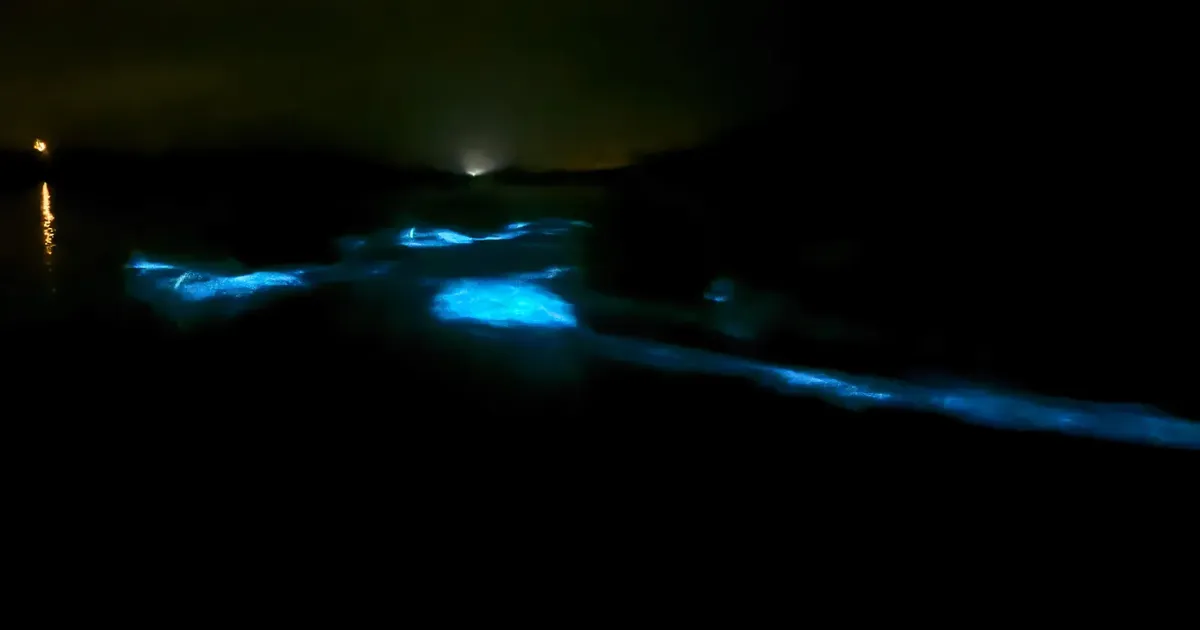
The water in Puerto Rico’s bio bays glows because of a single-celled plankton, Pyrodinium bahamense. When something disturbs the water, each cell gives off a chemical flash that lasts about a tenth of a second. Three bays hold these cells in such numbers that every paddle stroke lights up: Mosquito Bay on Vieques, Laguna Grande in Fajardo and La Parguera in Lajas.
This guide explains how that light is made, why it only happens in a few places and why you see it only at night. It also covers the question every visitor asks next, whether you can get in. The full bay-by-bay swimming rules have their own page, can you swim in the bioluminescent bay.
Check Availability
Quick answer: the glow, the swim rules and safety
Why does the water glow? Puerto Rico’s glowing water comes from Pyrodinium bahamense, a microscopic, single-celled dinoflagellate (a type of bioluminescent plankton). When a paddle, a fish or your hand disturbs the water, the pressure triggers a chemical reaction inside each cell. A molecule called luciferin reacts with oxygen with the help of an enzyme, luciferase, and gives off a blue-green flash lasting roughly a tenth of a second. Narrow mouths, shallow warm water and fringing mangroves keep the plankton trapped and fed in the three bays.
Which bays allow swimming?
| Bay | Swimming allowed? | Status and source | Confidence |
|---|---|---|---|
| Mosquito Bay (Puerto Mosquito), Vieques | No | Prohibited by the DRNA. Tours are limited to permitted operators, and operators close the bay the night before, the night of and the night after each full moon (operator FAQs, 2026) | High |
| Laguna Grande, Fajardo | No | DRNA ban, widely reported as effective in April 2007. We could not locate the order text | High that it is banned; the date is medium |
| La Parguera (Bahía Fosforescente), Lajas | Offered on some licensed boat tours (usually about 20 minutes) | Discover Puerto Rico (2026) says swimming is permitted “on most nights.” At least one operator cites DRNA Administrative Order 2023-02 as banning it. Public summaries of the order (June 2023) mention only full-moon closures and motorboat enforcement | Medium: confirm with your operator |
Is it safe? For swimmers and paddlers, the evidence says yes. Pyrodinium bahamense can produce saxitoxin, a shellfish-poisoning toxin, in other parts of the world. A peer-reviewed study in Microorganisms (vol. 9, issue 6, article 1128, May 23, 2021) states that the species blooms in Puerto Rico’s bio bays “though no toxicity reports exist for PR populations.” Saxitoxin harms people who eat contaminated shellfish or pufferfish; touching the water does not. The bigger risks on a night swim are ordinary ones: dark, deep water and boat traffic.
What is bioluminescence?
Bioluminescence is light made by a living thing through a chemical reaction. NOAA defines it as a form of chemiluminescence, “the production of visible light by a chemical reaction.” When that reaction happens inside an organism, it is called bioluminescence. It is cold light: NOAA notes the reaction happens “without giving off much heat.”
- Bioluminescence in one line: living light, made chemically. No sunlight is needed to “charge” it.
- A bioluminescent bay: a coastal bay or lagoon where bioluminescent plankton are concentrated enough, and consistently enough, that the water visibly glows when disturbed, often year-round.
- How common it is: rare on land (fireflies, some fungi) and common at sea. NOAA’s Ocean Today notes that most groups of ocean animals, “from bacteria to sharks,” include light-makers.
Bioluminescence vs. fluorescence vs. phosphorescence
People mix these up constantly, and Spanish adds to the confusion: La Parguera’s bay is officially Bahía Fosforescente.
| Term | What happens | Needs outside light? | Example |
|---|---|---|---|
| Bioluminescence | An organism makes light through a chemical reaction | No | Puerto Rico’s bio bays, fireflies |
| Fluorescence | Absorbs light and instantly re-emits it as a different color | Yes, and it stops when the light stops | Coral under a UV torch |
| Phosphorescence | Absorbs light and re-emits it slowly, over a longer time | Yes, it “charges” | Glow-in-the-dark stickers |
Definitions follow NOAA Ocean Exploration. “Phosphorescent bay” is a historical misnomer; the bays are bioluminescent.
Meet the organism: Pyrodinium bahamense
The glow comes mostly from one species, Pyrodinium bahamense (“whirling fire from the Bahamas”), an armored dinoflagellate. Govender and Jury (2024, Revista de Biología Tropical) call it the “dominant bioluminescent dinoflagellate” in Puerto Rico’s bays.
A dinoflagellate is a single-celled organism with two whip-like flagella that make it spin as it swims, hence “whirling.” Many dinoflagellates photosynthesize like plants, which is why people loosely call them “bioluminescent algae.” Because they drift with currents, they are also plankton. Both labels are fair, and “dinoflagellate” is the precise one.
Key biology:
- Size: cells measure 33–71 µm long and 33–67 µm across, per the Marine Species Identification Portal’s taxonomic summary. That is about the width of a human hair, so a single cell is invisible to you. PBS NOVA puts it another way: 200 to 300 of them could rest on the head of a pin.
- Armor: a “strongly developed theca” (cellulose plates) with spines. The Atlantic variety lives alone or in pairs and “does not form chains.”
- Two varieties: var. bahamense (Atlantic and Caribbean, including Puerto Rico) and var. compressum (Indo-Pacific, which forms chains of 2–32 cells).
- Life cycle: besides the swimming cell, Pyrodinium forms a spiny resting cyst that can sit in bottom sediments. That is one reason bays can “reseed” after a crash.
- Picky eater: Pyrodinium is hard to grow in labs. Researchers found that soil-derived nutrients such as selenium boost growth, which suggests it depends on inputs from the land. Dr. Edith Widder told NPR (2017) that mangroves “provide an essential vitamin to the dinoflagellates.”
How does bioluminescence work? The chemistry, step by step
In short: a jolt opens a proton channel, a drop in pH frees luciferin, luciferase oxidizes it, and a photon of blue-green light (about 475–480 nm) comes out. Here is the sequence.
- The trigger (mechanical stimulation). A paddle, fish or hand creates shear (fluid stress) that deforms the cell’s membrane.
- An electrical signal. That stress fires an action potential, an electrical impulse, across the vacuole membrane. Research on dinoflagellates identified a voltage-gated proton channel (Smith et al., 2011, PNAS; Rodriguez et al., 2017, PLOS ONE).
- Acid rush into the scintillons. The cell’s central vacuole is very acidic (pH about 3.5–4.5). The opened channels let protons flood into tiny light-making organelles called scintillons, dropping their internal pH from about 8 to about 6.
- Luciferin is released and luciferase switches on. At pH 8, luciferin is locked up by a luciferin-binding protein. At pH 6 it is released, and the enzyme luciferase becomes active (Liu et al., 2004, PNAS). Low pH does both jobs at once.
- Light. Luciferase catalyzes the oxidation of luciferin, a tetrapyrrole and a chemical cousin of chlorophyll, the green pigment in plants. The excited product releases energy as a blue flash (about 480 nm, per a 2022 review in PMC). Inside an intact scintillon the flash lasts about 100 milliseconds, matching what is measured in living cells.
Our bio bay kayak tours guide quotes the lab timings for the onset of each flash, which comes within a few hundredths of a second of the touch; the 100 milliseconds here is the length of the flash itself.
Accuracy note: much of the detailed chemistry was worked out in a related dinoflagellate, Lingulodinium polyedra. A 2004 PNAS study found that dinoflagellate luciferases share the same pH-regulating histidines, “indicating that bioluminescence in these species is pH-triggered by the same mechanism.” We assume Pyrodinium works the same way, which is reasonable but not separately proven in every detail.
Why does it flash when you disturb the water?
The flash is a defense, and it fires only when something touches the cell. Scientists have three main explanations, summarized by Hanley and Widder (2017), and they may all be partly true.
- Startle response: a sudden flash spooks the grazing copepod (a tiny crustacean) mid-bite, and it lets go.
- Burglar alarm: the flash lights up the grazer for its predators, such as fish. Burkenroad first proposed this in 1943, Abrahams and Townsend (1993) supported it experimentally, and Huang et al. (2024, Functional Ecology) refined it. They found that a single flashing cell makes copepods jump, and that motion draws in predators.
- Warning signal: “I’m not worth eating.” Prevett et al. (2019, Current Biology) showed copepods reject bioluminescent Lingulodinium in favor of less defended prey.
That is why the bay looks dark until you move. Still water barely glows, and the light shows up where paddles, fish and bodies stir it.
Why does it glow only at night?
An internal circadian clock controls the glow. Cells stock up their light-making machinery at night and dismantle much of it by day, and daylight would drown out the flash anyway. A 2004 PNAS study notes that dinoflagellate bioluminescence “is circadian, with daily fluctuations in the abundance” of luciferase, luciferin-binding protein, luciferin “and the number of scintillons.”
In practice:
- Daytime: even a perfect flash would be invisible against sunlight.
- Night: the cells are primed and your eyes are dark-adapted. Moonlight and artificial light work against you.
- Moon: a full moon does not stop the flashing, but it washes it out. Mosquito Bay and La Parguera close to tours around the full moon (see below).
Why are these specific bays so bright?
Puerto Rico’s three bays hold the plankton in, feed them and keep conditions stable, and most coastlines do none of these. The ingredients below are drawn from Guinness World Records, Govender and Jury (2024), the Vieques Conservation and Historical Trust (VCHT) and NPR’s interview with Edith Widder.
| Factor | Why it matters | Where it shows up |
|---|---|---|
| Narrow, restricted mouth | Keeps cells from being flushed out to sea, so water lingers (long residence time) | Guinness credits Mosquito Bay’s “narrow mouth” |
| Shallow, warm water | Concentrates cells and favors growth; Govender and Jury cite sea temperatures of 24–29 °C | Laguna Grande averages about 3 m deep |
| Red mangroves | Decaying leaves supply organic nutrients and vitamins; roots stabilize sediment | Widder (NPR 2017): mangroves “provide an essential vitamin” |
| Calm winds, low turbidity | Strong winds can push cells out; murky water hides the glow | Mosquito Bay dimmed in 2014 after rough seas and a wind shift |
| Salinity balance | Heavy freshwater runoff lowers salinity and stresses cells | After Hurricane María, PBS NOVA reported lowered salinity in Mosquito Bay |
| Darkness | Light pollution reduces the visible glow | The Vieques trust has pushed for shielded amber lighting |
The “Spanish boulders” legend: a 2010 Worcester Polytechnic Institute project report repeats a local story. Spaniards supposedly tried to block Laguna Grande’s mouth with boulders, which reduced outflow and increased the glow. We could not verify it historically, so treat it as folklore.
Mangroves alone are not enough. Wikipedia’s Pyrodinium summary notes the species is absent from parts of mangrove-rich Florida Bay. The bays glow because all of these factors come together. Scripps bioluminescence expert Dr. Michael Latz describes year-round glowing bays as extremely rare mangrove ecosystems, “with a total area less than 5 sq km in the Caribbean.”
Where are the bioluminescent bays in Puerto Rico?
- Mosquito Bay (Puerto Mosquito), Vieques. On the island’s south coast near Esperanza. The National Park Service lists it as a National Natural Landmark designated in 1980, noting it “supports the highest concentrations of dinoflagellates… making it the brightest and best example of a bioluminescent bay.” Guinness World Records lists it as the “brightest bioluminescent bay,” a record dated January 2006. Getting there takes a ferry or a flight (how to get to Vieques; Mosquito Bay guide).
- Laguna Grande, Fajardo. On the northeast tip in the Las Cabezas de San Juan reserve, reached by paddling a mangrove channel from Las Croabas, about 45–60 minutes from San Juan (Laguna Grande guide; day trips from San Juan).
- La Parguera (Bahía Fosforescente), Lajas. On the southwest coast, roughly 2–2.5 hours’ drive from San Juan per Discover Puerto Rico. It is the only bay that allows motorboat tours (La Parguera bio bay tours).
All three are covered side by side in our guide to Puerto Rico’s bioluminescent bays.
How many bioluminescent bays are there in the world?
There is no official count. The popular “five in the world, three in Puerto Rico” line is a travel-industry talking point, not a scientific figure.
- The “five” list usually reads: Mosquito Bay, Laguna Grande, La Parguera, Jamaica’s Luminous Lagoon and Vietnam’s Halong Bay. We found no scientific survey behind it. Halong Bay’s bioluminescence is seasonal and different in character from a year-round Pyrodinium bay.
- A more defensible number: Dr. Michael Latz told a public lecture on St. Thomas (reported by the St. Thomas Source, June 14, 2013) that bioluminescent lagoons are “gems,” with “only seven year-round lagoons known to exist in the Caribbean.” Even that is a 2013 regional estimate, not a global census, and a Discover Magazine piece listing the year-round Caribbean bays Latz names counts six: Puerto Rico’s three, Jamaica, Grand Cayman and Salt River Bay.
- Other year-round Pyrodinium bays: Salt River Bay on St. Croix (U.S. Virgin Islands), which also hosts comb jellies and glowing fireworms (Odontosyllis); Jamaica’s Luminous Lagoon near Falmouth; and Florida’s Indian River Lagoon, which has seasonal Pyrodinium blooms.
- Famous glowing water that is not a bio bay: the Maldives “Sea of Stars” (Vaadhoo), whose glow is attributed variously to Noctiluca, Lingulodinium or ostracod crustaceans (sources disagree); San Diego’s red tides (Lingulodinium polyedra), which Latz’s lab notes appear unpredictably, “only every couple of years”; and Japan’s Toyama Bay, whose glow comes from firefly squid.
Saying Puerto Rico has “three of the world’s few year-round bioluminescent bays” is accurate. “Three of the world’s five” is not.
How bright is each Puerto Rico bay?
Mosquito Bay holds the record, and all three bays fluctuate a lot. Densities can swing more than tenfold within a year.
| Bay | Published concentration data | Source and date | Notes |
|---|---|---|---|
| Mosquito Bay | Up to 700,000 cells per gallon (about 185,000 per liter) | Guinness World Records, record dated Jan 23, 2006 | Basis of the “brightest bay” title |
| Mosquito Bay | About 100,000 per liter (2017, before María), then nearly 600,000 per liter (June 2018) | VCHT data via CNN | Post-hurricane surge |
| Mosquito Bay | About 75,000 per liter at one sampling site on a reporting night | PBS NOVA (2018), VCHT’s Mark Martin-Bras | Spot reading |
| Laguna Grande | Monthly counts from 4,388 cells per liter (Jun 2018) to 2.19 million cells per liter (Nov 2019); monthly means peak in November (about 1.06 million per liter) | Govender and Jury, Rev. Biol. Trop. 72 (2024), 2016–2021 sampling | Low in 2016–17; strong blooms 2018–20 |
| Laguna Grande | 0.48 to 90,978 cells per liter, mean about 18,959 per liter; higher April–September | Sastre et al., Rev. Biol. Trop. (2013), three-year study | Far lower than the 2024 figures; methods differ |
| La Parguera | Abundance rises in the wet season (August–November) with warmer water and lower salinity | Soler-Figueroa and Otero (2014, 2016), cited in Govender and Jury 2024 | Widely described by visitors as the dimmest of the three |
How to read this table:
- Don’t compare numbers across studies directly. Sampling depth, site, season and lab methods differ. The 2024 Laguna Grande peak (2.19 million per liter) is far above Mosquito Bay’s Guinness figure, and that does not make Laguna Grande brighter. Different years, methods and conditions produced those numbers.
- Some web figures are unreliable. Travel sites quote “1–2.1 million per gallon,” “2.4 million per gallon” and even “3 million per gallon” for Mosquito Bay with no traceable source. We don’t repeat them.
- Cell count and visible brightness don’t always match. After María, Laguna Grande had roughly pre-storm cell counts, but “the bioluminescence just isn’t the same,” Leonor Alicea told PBS NOVA (2018).
What bioluminescence looks like in person
In person the glow is fainter and sparklier than in photos, and it moves: think blue-green sparks and comet trails, not a neon-lit swimming pool.
- Why photos look brighter: most glowing-bay images are long exposures on a tripod that stack thousands of 0.1-second flashes into one frame. Discover Puerto Rico’s own guide lists “Rely on photos — the glow rarely shows up” as a don’t.
- What you’ll see: paddle swirls that glow and fade, droplets that sparkle as they fall, fish leaving ghostly streaks, and on good nights a blue halo around your kayak.
- Your eyes need 15–20 minutes of darkness to adapt. Keep phone screens off.
- Clear-bottom kayaks show fish and glow beneath you; standard kayaks show the glow best at the paddle. Our clear kayak vs kayak vs electric boat guide compares what each hull shows.
Can you swim in the bioluminescent bay? Bay-by-bay rules
Only at La Parguera, and only on a licensed tour that sells a swim. Mosquito Bay and Laguna Grande ban swimming outright. The detail, with the tours that include a swim, is on our swimming guide; the summary is here.
| Bay | Swim? | Rule and date | How you experience it instead | What we couldn’t verify |
|---|---|---|---|---|
| Mosquito Bay | No | DRNA prohibition, in place by at least 2014, alongside DRNA Administrative Order 2014-03, a temporary use moratorium signed May 2, 2014. Operators note “Swimming in Bahía Mosquito is strictly prohibited.” Tours close the night before, the night of and the night after the full moon | Kayak, clear kayak or electric boat with a permitted operator (Mosquito Bay guide) | The exact order and date of the original ban |
| Laguna Grande | No | DRNA ban, “effective in April 2007” (Puerto Rico Day Trips). A 2010 WPI report quotes the DRNA’s Dr. Lilyestrom saying the ban was recent | Guided kayak through the mangrove channel (Laguna Grande guide) | Order number and primary text |
| La Parguera | Offered on most nights by licensed boat tours | Swims are typically about 20 minutes (Caribbean Breeze Adventures listing, 2026). DRNA Administrative Order 2023-02 (June 8, 2023) closes the bay three nights around each full moon and targets unpermitted motorboats | Swim from the boat, kayak, glass-bottom boat or water bike (La Parguera bio bay tours) | Whether AO 2023-02 restricts swimming. One operator says it does; press coverage of the order doesn’t mention swimming |
The La Parguera conflict, explained
- Sources that say you can swim (2026): Discover Puerto Rico’s La Parguera profile says it is “the only one where swimming in the bioluminescent water is permitted on most nights.” Several licensed operators sell boat-and-swim tours and note that “the number of participants is monitored by the DRNA.”
- Sources that say you can’t (2026): Caribbean Chiliboats, which runs the La Parguera: Bioluminescent Bay Water Bike Tour (4.8/5 from 106 reviews), states “Swimming is not permitted (Administrative Order 2023-02, DRNA)” and “swimming or entering the water is strictly prohibited.”
- Discover Puerto Rico contradicts itself. Its main bio bay guide says both “Expect to swim (except at La Parguera)” and, in its FAQ, “Swimming is not allowed in any of the bio bays.”
- The order, as far as the public record shows: reports from WIPR and Primera Hora (June 8, 2023) describe AO 2023-02 as establishing “el cierre temporal de la Bahía durante tres días de luna llena en cada ciclo lunar” (a closure of three nights at each full moon), with the first closure on June 18–20, 2023, in response to visitors using motorboats illegally and without permits. Neither report mentions swimming. The order text is not posted in the DRNA’s online order index.
- Where that leaves you: swimming at La Parguera is currently offered and widely advertised. The rule may differ by permit type, with some concessions (such as pedal-boat tours) barring water entry while others allow it. Ask your operator directly: “Does your DRNA permit include swimming?”
Why is swimming banned in the bio bays?
Regulators want to cut human contamination and physical disturbance in tiny, slow-flushing bays where every pollutant lingers. The reasons regulators and operators give:
- Sunscreen, lotions and insect repellent. Operators and the Vieques trust say DEET-based repellents and sunscreens harm the dinoflagellates. One Vieques operator’s FAQ says DEET “kills the microorganisms that make the biobay glow.” We found no peer-reviewed dose-response study on DEET and Pyrodinium specifically, so treat this as a sensible precaution. In a bay with restricted flushing, residues from thousands of visitors add up.
- Sediment stirring and trampling in shallow bays with soft, mucky bottoms. The organisms are fragile in ways you can’t see from a kayak.
- Crowding history. Mosquito Bay went dark in early 2014. AP, via Phys.org, reported that officials blamed rough seas for the January dimming and called the later fade unclear. Afterward Vieques tightened its rules: changed lights, no swimming, licensed operators only.
- Results: the authors of Puerto Rico Day Trips say that on a revisit, the Laguna Grande ban “has had a positive effect on the health (brightness) of the bio bay.” That is anecdotal, and it fits what the managers were aiming for.
Is bioluminescent water toxic or dangerous?
For swimmers and paddlers in Puerto Rico, the evidence says no. The real toxin risk with Pyrodinium comes from eating contaminated seafood, not from skin contact.
- The toxin: Pyrodinium bahamense is one of only three marine dinoflagellate genera known to make saxitoxin (STX), the cause of paralytic shellfish poisoning (PSP) and saxitoxin pufferfish poisoning, according to a 2024 Marine Drugs study.
- Pacific vs. Atlantic: scientists long believed var. compressum (Pacific) was toxic and var. bahamense (Atlantic) was harmless. A 1972 toxic bloom in Papua New Guinea, and later Florida findings, upset that tidy split. Florida’s Indian River Lagoon has had STX in pufferfish and shellfish linked to P. bahamense, which led to state monitoring.
- Puerto Rico specifically: a 2021 Microorganisms study (vol. 9, article 1128) found the saxitoxin gene sxtA4 in some Mosquito Bay cells. Its abstract reports the gene’s frequency there “ranged from ca 40–66%,” falling between July and September. It still states plainly that “no toxicity reports exist for PR populations.” Having the gene does not prove toxin production, and the authors say the link is “not known.” The 2024 Marine Drugs study adds that Puerto Rico populations “are not routinely measured for toxicity; in general, it is assumed they are non-toxic.”
- For you as a visitor:
- Swimming or touching: no documented harm in Puerto Rico’s bays.
- Don’t drink the water or eat shellfish harvested from bio bays. Harvesting in protected reserves is a bad idea anyway.
- Is bioluminescence dangerous in general? No. Making light is harmless. Some bioluminescent species are toxic, and you can’t judge toxicity from the glow.
- Practical hazards matter more: night-time disorientation, boat traffic, depth and fatigue.
Swimming at La Parguera: what to expect
Expect a short, supervised dip of about 20 minutes off a small boat, in open water at night. It is not a beach wade. Boats such as the La Parguera: Sunset and Biobay or Late Night Biobay Cruise (4.8/5 from 580 reviews) and the La Parguera: Bioluminescent Bay Boat Tour (4.6/5 from 296 reviews) leave from the waterfront; ask either one whether its permit includes a swim before you book.
- Format: boats leave the La Parguera waterfront for a 15–25-minute ride. Total time on the water runs about 45–60 minutes, and swimming is optional (Caribbean Breeze Adventures listing, 2026).
- Depth: visitors and operators describe La Parguera as deeper than the other two bays. One 2026 TripAdvisor reviewer called it “a deeper bay than the other bio-bays.” Expect to tread water or float, not stand. We didn’t find a published depth for the swim area.
- Gear: life jackets or flotation are typically provided and may be required. Use them.
- What it feels like: every kick throws off sparks, your arms trace glowing outlines, and looking down at your own body outlined in blue is the highlight. Brightness at La Parguera varies, and reviewers range from “surreal” to “fainter than I was expecting.”
- Before you go in: skip sunscreen, lotion and DEET that day, or rinse them off. Operators ask for this.
- Safety: stay within sight of the boat light, swim with a buddy, follow the captain’s whistle signals, and stay aboard if you’re uneasy in dark open water. Non-swimmers can trail a hand over the side.
- Wildlife: we found no reports of shark incidents in Puerto Rico’s bio bays. Jellyfish can be present, as in any Caribbean water, so ask your guide about current conditions.
- Full-moon closure: La Parguera closes three nights around each full moon under AO 2023-02, so check the lunar calendar.
If you want to swim and can’t make La Parguera, Jamaica’s Luminous Lagoon near Falmouth (fed by the Martha Brae River) allows swimming. Visit Jamaica says “visitors can swim in the light show.”
Threats and conservation: how visitors can help
The bays are fragile. Mosquito Bay has gone dark at least twice since 2014 (early 2014 and after María in 2017), and Laguna Grande had low seasons in 2003 and 2013.
Documented threats:
- Hurricanes. After María (September 2017), three of the four Caribbean bio bays Latz’s lab tracked went dark “due to multiple factors including freshwater runoff and high winds.” La Parguera was “largely spared.” Mosquito Bay stayed dim for weeks to months: NPR described weeks of dark water, and one operator paused tours for nearly nine months. Govender and Jury (2024) also found hurricanes can “rake and refresh” Laguna Grande, followed by strong blooms (2018–2020). Hurricane Fiona (2022) also hit Puerto Rico; we found no peer-reviewed data on its effects on the bays.
- Development, sedimentation and runoff, including mangrove loss and nutrient changes.
- Light pollution. Westindiestravel attributes some of Laguna Grande’s dimmer appearance to lit buildings on the hill.
- Overuse and unpermitted motorboats, the stated trigger for La Parguera’s 2023 order.
- Climate and sea-level shifts. Govender and Jury link density swings to salinity, sea level and air–sea conditions.
The DRNA manages all three reserves. The Vieques Conservation and Historical Trust co-manages Mosquito Bay and runs water-quality monitoring and dinoflagellate counts.
How you can help:
- No DEET, sunscreen or lotions on tour day. Use DEET-free repellent only if your guide approves.
- Book licensed, DRNA-permitted operators only; our best bio bay tours compared guide lists them.
- No swimming where it is banned, and no “quick dips.”
- Keep lights and flash off. Use red lights only if a guide asks.
- Don’t stand on or kick the bottom, and don’t grab mangrove roots; our mangrove kayaking guide has the full etiquette.
- Don’t take water samples home.
- Support the VCHT or local mangrove replanting efforts.
Common misconceptions
- “Glowing water means toxic red tide.” Not necessarily. Some bioluminescent dinoflagellates form harmful blooms elsewhere, but color and glow don’t tell you toxicity, and Puerto Rico’s bays have no toxicity reports (2021 study).
- “It’s phosphorescence.” No. Phosphorescence is stored light; this is chemical light (see the table above).
- “They glow all the time.” They flash only when disturbed, mostly at night.
- “It’s bacteria.” Some bioluminescent bacteria exist, but Puerto Rico’s glow comes from a dinoflagellate, a protist.
- “The photos show what you’ll see.” Long exposures exaggerate it.
- “A full moon means no glow.” The cells still flash, but moonlight washes them out.
- “Rain ruins it.” The evidence is mixed. Raindrops can make the surface sparkle, and wet-season months often have higher densities (Laguna Grande peaks August–November; La Parguera rises in the wet season). Extreme freshwater floods like María’s can darken a bay for a while.
Best time to see bioluminescence
Go on a dark night close to the new moon, at least an hour after sunset, ideally from late summer to fall, when the water is calm. Full planning is in our best time to see the bioluminescent bay guide.
| Factor | Best | Avoid |
|---|---|---|
| Moon | New moon to thin crescent, or before moonrise | The three nights around the full moon (Mosquito Bay and La Parguera close) |
| Time | About an hour or more after sunset, in full darkness | Twilight |
| Season | Data favor August–November at Laguna Grande (Govender and Jury 2024) and the wet season at La Parguera | Late-winter lows (February–May at Laguna Grande) |
| Weather | Calm, light winds | Strong winds; the days after major storms |
| Light | Cloud cover on a calm, moonlit night can help | City glow, phone screens |
Does it glow every night? The plankton are present year-round, but brightness varies nightly and can collapse for a while after storms. Operators will usually tell you if a bay is weak.
Can you see it from shore?
Usually not well. You need to disturb the water, in darkness, where cells are concentrated. At Laguna Grande, Las Cabezas de San Juan Nature Reserve has offered night tours where you can “see and play with the bio-luminescent water without too much physical effort” (Puerto Rico Day Trips). At La Parguera and on Vieques, the densest glow is out in the bay, away from town lights; docks are too lit and too far from it. A tour is the reliable way in (bio bay kayak tours).
Can you take some glowing water home?
No, and it wouldn’t work anyway. The cells need specific nutrients and conditions, flash only when disturbed at night, and won’t survive long in a bottle. The bays are DRNA nature reserves, so taking anything out is inappropriate at best. We did not find a specific statute, so ask your guide about local rules.
FAQ
Why does the water glow in Puerto Rico? Microscopic dinoflagellates, mainly Pyrodinium bahamense, flash blue-green when the water moves. Three bays (Mosquito Bay, Laguna Grande, La Parguera) trap them in huge numbers thanks to narrow mouths, shallow warm water and mangroves.
What causes bioluminescence? A chemical reaction. Mechanical stress triggers a pH drop inside organelles called scintillons, which frees luciferin and activates luciferase. Luciferin then oxidizes and gives off light for about 0.1 seconds.
Is bioluminescent water dangerous or toxic? Not to swimmers in Puerto Rico. Pyrodinium can make saxitoxin elsewhere, but a 2021 Microorganisms study reports “no toxicity reports exist for PR populations.” Don’t drink the water or eat shellfish from bio bays.
Can you swim in the bio bay? Only at La Parguera, on licensed boat tours that include a swim (usually about 20 minutes). Swimming is banned at Mosquito Bay and Laguna Grande.
Which bay allows swimming? La Parguera (Bahía Fosforescente) in Lajas. Some operators cite DRNA Administrative Order 2023-02 as banning water entry, so confirm with your operator before booking.
Why can’t you swim in Mosquito Bay? The DRNA prohibits it to limit contamination from sunscreen, repellents (especially DEET) and physical disturbance in a slow-flushing bay. The rules tightened after the bay went dark in 2014.
Can you see it from the shore? Rarely well. The glow needs darkness, disturbed water and concentrated cells, which are found out in the bay. A guided kayak or boat tour is the reliable way.
Does it glow every night? The plankton live there year-round, but brightness varies with the moon, weather and cell density. Storms can dim a bay for a while. Mosquito Bay and La Parguera close around each full moon.
Can you take some home? No. The cells won’t survive long or glow reliably in a bottle, and the bays are protected DRNA reserves.
How many bioluminescent bays are there in the world? No official count exists, and the “five in the world” claim is unsourced. Scripps researcher Michael Latz, in a 2013 St. Thomas lecture, cited “only seven year-round lagoons known to exist in the Caribbean,” including Puerto Rico’s three; other lists of his name six.
Does rain affect it? Light rain can make the surface sparkle, and wet-season months often bring higher densities. Extreme freshwater floods, like Hurricane María’s, can darken bays for weeks to months.
Is it algae or plankton? Both labels fit. Dinoflagellates are single-celled, mostly photosynthetic protists (“algae”) that drift with currents (“plankton”). “Dinoflagellate” is the precise term.
Ready to see it? Compare operators in our best bio bay tours compared guide, or start with the overview of Puerto Rico’s bioluminescent bays.
See the Water Light Up
Paddle into Laguna Grande with the operator 275 guests rated 4.6/5 — small groups, a full safety briefing, and free cancellation up to 24 hours before.
Check Availability & Book